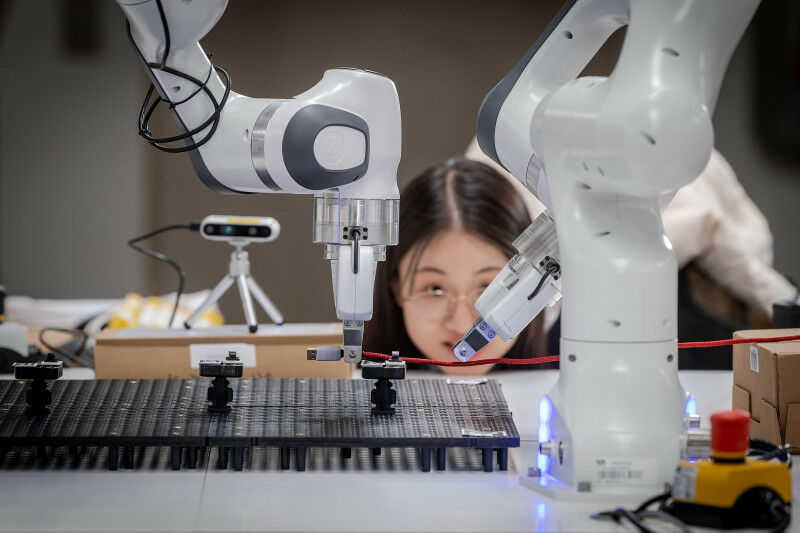
Scientist Keija Chen watches her robot move cables into the right position
New TUM Robotics Lab at the Deutsches Museum. Scientist Keija Chen watches her robot move cables into the right position In a new research laboratory at the Technical University of Munich (TUM) in the Deutsches Museum, humans and robots are working closely together. The goal of the KI.Fabrik flagship project is to develop flexible, learning-enabled robots that support people in their work with the help of artificial intelligence (AI). Today's factories originated in times with large production runs and programming techniques that enabled robots to perform countless perfect repetitions of a specific task. But customer expectations have changed, as more and more goods are produced in small numbers. Consequently, factories will also be transformed. "To design specialized, individual products - often with mechatronic characteristics - and produce them quickly at reasonable cost, we will need scalable, flexible manufacturing methods as well as learning-enabled robots," says Prof. Klaus Bengler of TUM.
UM DIESEN ARTIKEL ZU LESEN, ERSTELLEN SIE IHR KONTO
Und verlängern Sie Ihre Lektüre, kostenlos und unverbindlich.