Pieces of metal and nails from the mosque.
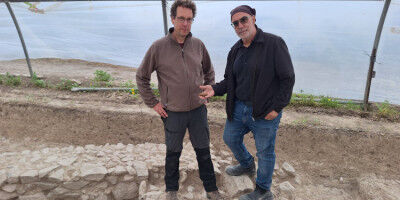
Team of Archaeologists Discovered Parts of the Wooden Dome and Fragments of the Mosque Window. During excavations near Wünsdorf, about 40 kilometers south of Berlin, archaeologists from Freie Universität Berlin, in cooperation with the Brandenburg Landesamt für Denkmalpflege (State Office for Heritage) and State Archaeological Museum as well as the ABD Dressler company, have found remains of the oldest mosque in Germany. (The mosque in Schwetzingen is older, but it was not built to be functional as a mosque.) The team led by professors Reinhard Bernbeck and Susan Pollock discovered wires and iron bolts used to brace up the wooden dome as well as green and blue glass shards from the mosque's windows. They were also able to determine the location of the mosque that was consecrated 100 years ago. The southern veranda of the mosque along with the minaret were also uncovered. On the site, which is currently a parking lot, there were also a prayer room and the northern courtyard of the mosque, but the archaeologists did not dig in that section. Overall, only a few remnants of the building were preserved because there were many changes to the site during the decades after the mosque was torn down. First the National Socialists and then the Soviet Army used it for military purposes. The so-called Crescent Moon Camp was set up during World War I specifically for prisoners of war who were Muslims. There they were supposed to be indoctrinated to fight against their colonial masters, France, England, and tsarist Russia. At the same time, they were abused as "exotic scientific objects" and studied in accordance with racist teachings common at the time in the fields of ethnology and anthropology.
TO READ THIS ARTICLE, CREATE YOUR ACCOUNT
And extend your reading, free of charge and with no commitment.