Plant biotechnologist Gundula Noll on the plant immune response and the role of electrical impulses

Is the plant immune response comparable to that of animals and humans?
No. Plants have their own way of defending themselves. While animals have specialised immune cells that specifically seek out and eliminate pathogens, plants have to proceed differently. They do not have a circulating immune system that wanders through the body, but react locally and systemically with a sophisticated signalling system. When an attacker is detected, affected cells send out chemical and electrical alarm signals that activate defence mechanisms - their own biological early warning system, so to speak. These signals spread via the vascular tissue, especially via the phloem, which is actually responsible for transporting nutrients. So plants do not get fever - instead they boost their defence mode.
How well researched is the immune system of plants?
There are still plenty of exciting mysteries. It is particularly fascinating that plants do not work with just one type of signal, but with a mixture of electrical and chemical signals. It is not yet clear which of these signals set the tone. The current focus is on peptides and hormones, but the final proof is still missing. And then there is the question of how exactly these signals are processed? Electrical plant signals rush via the phloem through the plant - but what happens next? Which cells ’understand’ them and how do they finally trigger a defence response?
Why is it important to know how plants respond to pathogens?
It is the key to sustainable crop protection. The better we understand how plants activate their natural defences, the more targeted we can support them - without the massive use of chemicals. This will not only help the environment, but also agriculture by enabling robust crop varieties that can defend themselves against new pathogens. Especially in times of climate change, when new pathogens suddenly emerge, we need plants that are resilient.
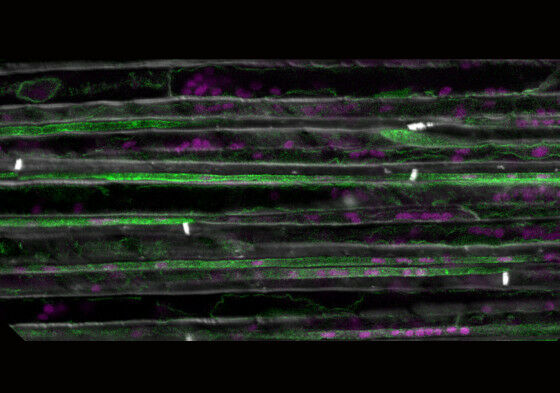
Your current work shows that harmful bacteria trigger electrical impulses and other reactions in the plant. How does this work?
You can imagine it as a kind of plant nervous system - only without a brain. As soon as the plant senses a bacterial signal, certain ion channels in the cell membranes are activated and set off a chain reaction. Charged particles flow through the cells and generate an electrical wave that spreads across the phloem. This is similar to the way nerve cells work - not quite as fast, but extremely effective. These electrical signals trigger a whole cascade of defence reactions: They activate chemical signals such as calcium ions and reactive oxygen compounds, which initiate the actual counterattack against the pathogen.
Were you surprised by your results?
Definitely. It was particularly exciting that we found this mechanism in two very different plant species - thale cress and field bean. This shows that this strategy is evolutionarily proven and probably plays a role in many plants. Another highlight was the discovery of an unexpected role for special phloem barrier proteins (SEOR proteins). It was previously thought that they were only responsible for regulating the flow of nutrients. But no: they also have a function in the immune response. This opens new doors for research: could these proteins be specifically manipulated to make plants more resistant? There are numerous possibilities.
Original publication:
Furch A. C. U. et al. (2025): Transformation of flg22 perception into electrical signals decoded in vasculature leads to sieve tube blockage and pathogen resistance. Sci. Adv. Vol 11, Issue 9; DOI:10.1126/sciadv.ads6417