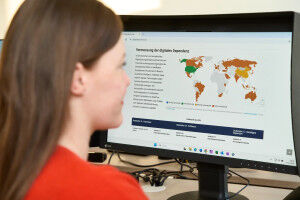
Online learning for free at every place around the world - MOOCs make it possible. (Image: A. Heddergott / TUM)
Campus news - The Technical University of Munich (TUM) is launching two new formats of Massive Open Online Courses (MOOCs). The "MOOCs for Masters" provide support to those applying for master's degree programs. MOOCs in the "edX Professional Certificate Program" offer targeted continuing education for working professionals. The English-language online courses are accessible worldwide at no charge. Does this degree program offer the content that I want to study? Can I handle the learning level involved? Graduates with bachelor's degrees can select from a wide range of possibilities when considering applying for a master's degree program. Since many master's degrees are more than just the continuation of a bachelor's curriculum, but rather are often interdisciplinary, it's not always easy for applicants to find their bearings, especially for those potentially interested from other countries. This is why TUM is now offering English-language online courses that provide an advance look inside master's degree programs. The content of the "MOOCs for Masters" consists of topics that are dealt with in the initial phase of the master's degree programs. The participants can thus check to see if they have properly assessed the topic and their own skills. They can also ask lecturers for their opinions and for suggestions on other possibilities in preparation for a degree program. "Software Engineering Essentials" begins today. The first MOOC in the series begins today: "Software Engineering Essentials?
UM DIESEN ARTIKEL ZU LESEN, ERSTELLEN SIE IHR KONTO
Und verlängern Sie Ihre Lektüre, kostenlos und unverbindlich.