Unique project provides data on greenhouse gas balance in Lünten Forest
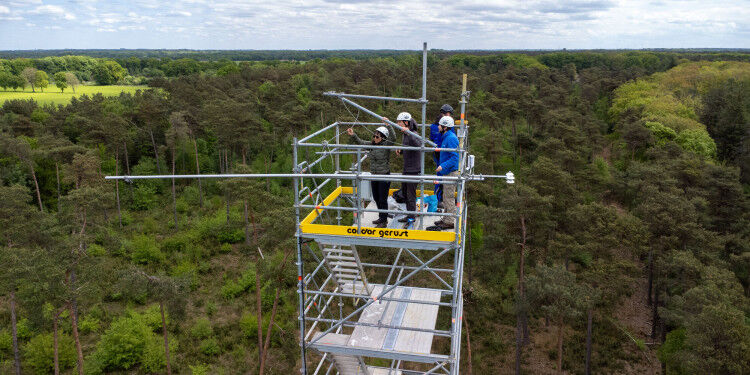
Around 70 kilometres west of Münster, right on the border with the Netherlands, lies the Lünten Forest - a nature reserve covering around 110 hectares in the municipality of Vreden in the district of Borken. Only a few remnants of the former peatland and heathland have survived. Today, pine trees and a network of deep drainage ditches dominate the landscape. But this forest is facing a remarkable change. It is being prepared for climate protection and is going to be rewetted. The goal: step by step, the area is to be transformed back into a near-natural peatland forest.
Peatland ecosystems are true wonders of nature. They store large amounts of carbon and thus act as natural carbon sinks. However, when peatlands are drained, as happened in the Lünten Forest, they have the opposite effect: they release greenhouse gases and exacerbate climate change. In 2022, the Global Peatlands Initiative presented the first global peatland map with the following data. Every day, 500,000 hectares of peatland are lost worldwide, releasing additional greenhouse gases. In Germany, emissions from drained peatlands amount to around 53 million tonnes of carbon equivalents per year, which is around seven per cent of total emissions. Projects such as the rewetting of the Lünten Forest are therefore of great importance. Success also depends largely on how the public is informed and involved. "From the outset, the project was developed in a co-planning process with stakeholders, nature conservation organisations and local authorities. This participation promotes knowledge transfer and creates acceptance because decisions are made jointly and practical issues are taken into account at an early stage," says Prof Mana Gharun from the Institute of Landscape Ecology at the University of Münster. This allows research to be transferred into practice more quickly and sustainably.
Whether this transformation is actually successful and which environmental factors play a role in it is now to be investigated by the newly established laboratory in nature - a joint project of the ÖLandschaftsverband Westfalen-Lippe" (LWL) and the University of Münster. The tower has been in operation since May of this year and is expected to measure data continuously for the coming years. Under the scientific direction of Mana Gharun, the tower was designed and its location precisely planned. The climatologist is also responsible for installing measurements devices and evaluating the greenhouse gas fluxes. The so-called "Eddy covariance tower" will initially record data on the forest’s greenhouse gas balance continuously for seven years - before, during and after rewetting.
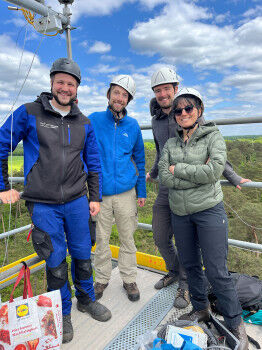
Students are also involved in They not only learn the theoretical aspects, but are also involved in the ongoing operation of the measurement setup, data collection and evaluation, for example as part of their final theses, study projects or as student assistants. In this way, they gain practical experience in natural sciences and in working with large, high-resolution data sets. In doing so, they use machine-learning methods for pattern recognition and modelling, for example. This practical training combines research and teaching and equips students with skills that are relevant to many areas of their professional life - from environmental monitoring to research and industrial applications.
The tower is not only a topic of conversation among the general public, but is also already a topic of discussion in the scientific community. "This station is connected to a global network for monitoring greenhouse gases. Through this network, we make freely accessible data available to the public, scientists from other disciplines and to politicians," reports Mana Gharun. In this way, the University of Münster enables the direct transfer of scientific knowledge to society.
This article is from the University newspaper wissen