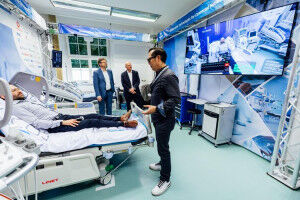
In-ear sensors can measure biodata like blood oxygen saturation, respiration rate and pulse. Scientists will use these devices to continually monitor COVID-19 patients' health. Image: Andreas Heddergott / TUM
In-ear sensors can measure biodata like blood oxygen saturation, respiration rate and pulse. Scientists will use these devices to continually monitor COVID-19 patients' health. Image: Andreas Heddergott / TUM - A team at the Technical University of Munich (TUM) plans to use high-tech biometric sensors for 24-hour monitoring of COVID-19 patients in home isolation. The goal of the study is to find out whether rapid treatment in response to deteriorating vital signs can improve the chance of survival and ease the workload of intensive care units. The study got off to a quick start thanks to donations. The illness caused by the new coronavirus, SARS-CoV-2, can be roughly divided into two stages. During the first stage, in which symptoms are not acute, infected individuals can generally remain at home.
UM DIESEN ARTIKEL ZU LESEN, ERSTELLEN SIE IHR KONTO
Und verlängern Sie Ihre Lektüre, kostenlos und unverbindlich.