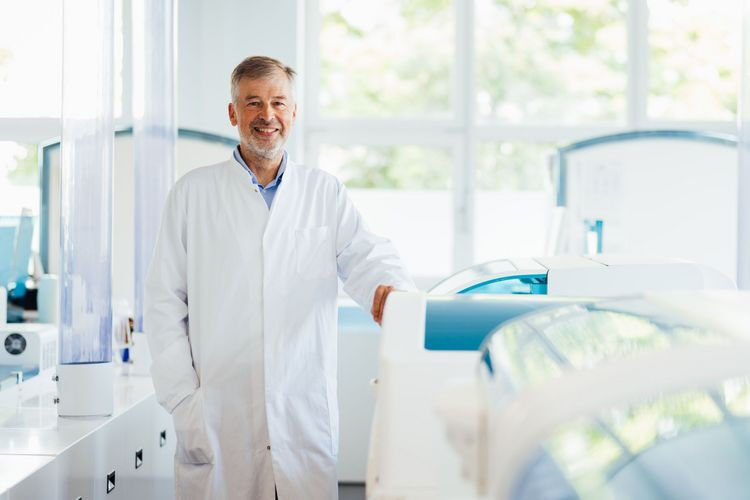
Berend Isermann became interested in the interactions between blood vessels, inflammation and coagulation early on in his medical career. During his training in internal medicine, the desire arose to develop a better understanding of this mysterious biological process called thrombo-inflammation. Today, as Professor of Laboratory Medicine at the University of Leipzig, this challenge has become the central theme of his scientific work.
"Thrombo-inflammation is a pathological process in which the balanced interaction between blood coagulation and inflammation is disturbed," explains Isermann. "It plays a role in almost all diseases." The phenomenon was particularly evident during the Covid-19 pandemic. In many cases, it was not the virus itself that was the cause of death, but the body’s uncontrolled reaction: it was thrombo-inflammation that led to severe complications. this disastrous experience has shown us that we do not yet have a therapy for thrombo-inflammation," emphasizes the physician.
Inflammation and coagulation processes are activated in the body during infections, injuries and pregnancy. In a healthy pregnancy, a certain amount of thrombo-inflammation in the placenta is completely normal. However, if this process gets out of balance, it can lead to complications such as pre-eclampsia. The disturbed course of these immune and coagulation processes also plays a central role in chronic diseases such as diabetes, kidney or heart disease.
Search for elementary switches
Nature shows us how: Cells make "decisions" in order to survive or die. Isermann wants to understand these processes so that stressed cells can be rescued and the function of organs can be preserved. In his latest research, he and his team were able to identify a molecular "switch" that regulates both processes - coagulation and inflammation - simultaneously. At the center of this is a well-known factor in blood coagulation: the tissue factor.
"We have discovered that the tissue factor in the kidney forms a previously unknown connection to a central inflammation regulator," explains Isermann. "This complex acts like a molecular switch that can turn thrombo-inflammation on or off." The tissue factor, originally known as a coagulation trigger, thus becomes the key to regulating a dangerous disease process in the human body.
In his work, the scientist has investigated further switches. For years, he has been working intensively on a receptor for coagulation factors that mediates both anti-inflammatory and inflammation-stimulating effects. In a further approach, he is investigating how these mechanisms regulate cellular metabolism and what influence this has on cell function and thus on organ function. "If we understand metabolism at a cellular level, we can also better understand metabolic diseases - and perhaps cure them," explains Isermann.
"If we understand metabolism at the cellular level, we can also better understand - and perhaps cure - metabolic diseases."
Berend Isermann
The Professor of Laboratory Medicine conducts his research in close cooperation with partners in Leipzig. The interplay between fundamental mechanisms at the cellular level and diseases in humans is very complex and, according to Isermann, can only be researched in collaboration. The Cluster of Excellence Leipzig Center of Metabolism - LeiCeM offers him and other participants an optimal framework for this: Isermann is researching mechanisms of receptor regulation, for example, in close collaboration with Annette Beck-Sickinger and Torsten Schöneberg from the Collaborative Research Center 1423 "Structural Dynamics of GPCR Activation and Signal Transduction" at Leipzig University. He is investigating the interaction of thrombo-inflammation and metabolism in close cooperation with the LeiCeM team of speakers, Michael Stumvoll, Antje Körner and Matthias Blüher. And in cooperation with Ulrich Laufs, Holger Thiele and Sabine Steiner, he is focusing on aspects of vascular diseases resulting from thrombo-inflammation.
Focus on new therapies
Isermann’s research group has now been able to identify a molecular switch in kidney diseases, in heart attacks in animal models, in Covid patients with severe courses and in auto-inflammatory diseases. The hope is that if it is possible to "turn off" the switch in a targeted and, above all, safe manner, many of these diseases could be better controlled or even prevented. The scientists’ aim is to develop new diagnostic methods to measure the activity of the switch in humans and link it to disease progression. In the long term, this should lead to therapeutic approaches - with the aim of specifically regulating thrombo-inflammation.
Professor Isermann’s path shows how valuable long-term scientific curiosity and interdisciplinary cooperation can be. From the basics of the cell biology of inflammation to potential new therapies for some of the most serious diseases of our time - the future of thrombo-inflammation research is medically highly relevant and more exciting than ever.