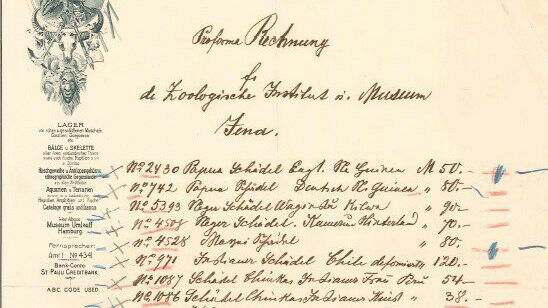
Proforma invoice (detail) from the Umlauff company dated 14.1.1908 to Ernst Haeckel. Image: Archiv/Ernst-Haeckel-Haus
Proforma invoice (detail) from the Umlauff company dated 14.1.1908 to Ernst Haeckel. Image: Archiv/Ernst-Haeckel-Haus - Knowledge Transfer and Innovation - Published: A scalp from Namibia and skulls from Tanzania and Papua New Guinea: these are examples of human remains from University of Jena collections that found their way to Germany during the colonial period. Extensive research has been necessary to uncover the precise origins and history of these human remains, as identification is nearly always difficult and labour-intensive. The University of Jena has been involved in such provenance research for years. " Friedrich Schiller University is well aware of its responsibility for its collections and therefore makes every effort to clarify the origins of these objects carefully and comprehensively ," says University President Prof. Walter Rosenthal. " We are focusing first on human remains, which do not belong in an exhibition, but rather in the care of descendants. " To this end, Prof. Rosenthal has therefore deployed the working group "Koloniales Erbe und rassismuskritische Bildungsarbeit" (Colonial Legacy and anti-racist Educational Work) to study this topic, starting this semester.
TO READ THIS ARTICLE, CREATE YOUR ACCOUNT
And extend your reading, free of charge and with no commitment.