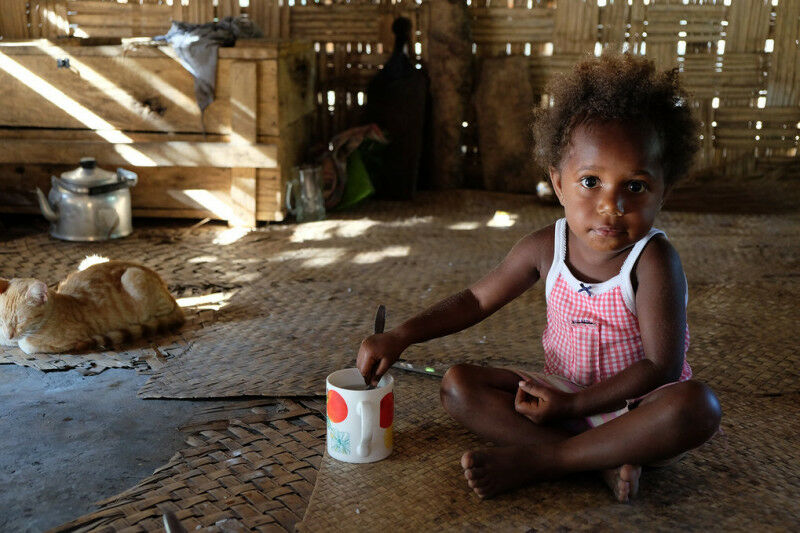
 Lewia Jimmysan from northwest Malakula was the first participant in the project, pictured here when she was almost 3 years old. She wears one of the team’s cotton t-shirts with a USB recorder in the breast pocket.
Researchers studied the vocal experiences of children growing up on Malakula Island in Vanuatu where multilingualism is the norm. Lewia Jimmysan from northwest Malakula was the first participant in the project, pictured here when she was almost 3 years old. She wears one of the team's cotton t-shirts with a USB recorder in the breast pocket. Heidi Colleran - How children acquire their mother tongue has always fascinated scholars. However, for the most part, these studies have focused on children growing up with only one mother tongue, and mostly, in the United States learning English. Researchers of the Language Acquisition across Cultures Research Group at the Laboratory of Cognitive Sciences and Psycholinguistics of the Ecole Normale Supérieure and Heidi Colleran, leader of the BirthRites Research Group at the Max Planck Institute for Evolutionary Anthropology (MPI-EVA), collaborated to study how children growing up in a multilingual society acquire language. Language learning is a human universal.
TO READ THIS ARTICLE, CREATE YOUR ACCOUNT
And extend your reading, free of charge and with no commitment.
Your Benefits
- Access to all content
- Receive newsmails for news and jobs
- Post ads