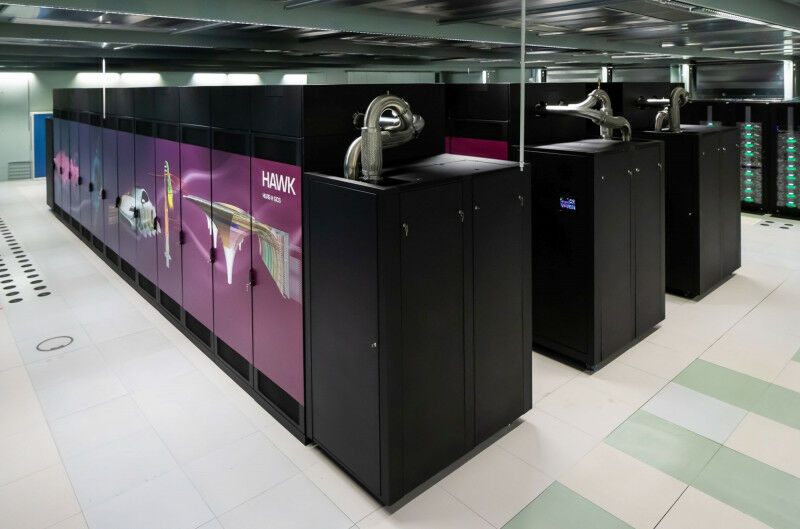
Addition of Graphic Processors Offers New Possibilities for Artificial Intelligence [Picture: University of Stuttgart/HLRS]
Addition of Graphic Processors Offers New Possibilities for Artificial Intelligence [ Picture: University of Stuttgart/HLRS] - The High-Performance Computing Center of the University of Stuttgart (HLRS) will add NVIDIA graphic processing units (GPUs) to its world-class supercomputer, Hawk. The change in architecture from a purely central processing unit (CPU)-based architecture to a hybrid system will enhance HLRS's capacity for deep learning applications and enable new kinds of workflows that combine simulation using high-performance computing and Big Data methods. "At HLRS our mission has always been to provide systems that address the most important needs of our key user community, which is largely focused on computational engineering," explained HLRS Director Dr.-Ing. Michael Resch. "For many years this has meant basing our flagship systems on CPUs to support codes used in computationally intensive simulation. Recently, however, we have seen growing interest in deep learning and artificial intelligence (AI), which run much more efficiently on GPUs. Adding this second key type of processor to Hawk's architecture will improve our ability to support scientists in academia and industry who are working at the forefront of computational research." Hawk, a Hewlett Packard Enterprise (HPE) Apollo system installed in 2020, is already one of Europe's most powerful high-performance computing (HPC) systems.
TO READ THIS ARTICLE, CREATE YOUR ACCOUNT
And extend your reading, free of charge and with no commitment.