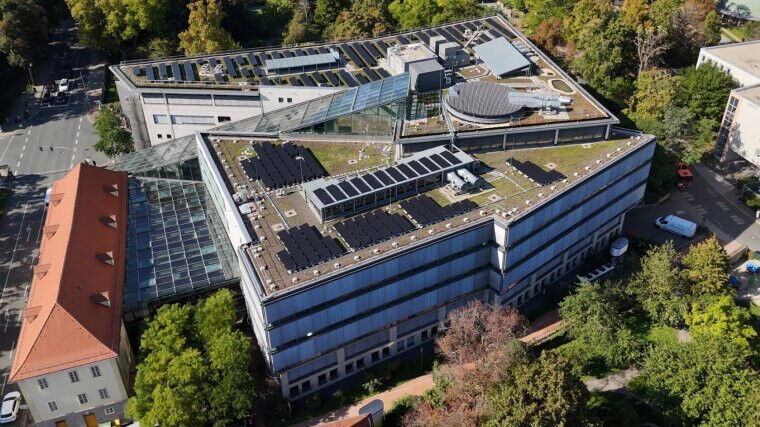
A photovoltaic system has been installed on the roof of the Thuringian University and State Library (ThULB). Visitors to the library can view live data from the system on a monitor in the foyer. The monitor displays information such as the current output of the system, the daily yield and the current CO2 savings. According to Maren Stieff from the Department of Construction and Real Estate at Friedrich Schiller University in Jena, the entire system covers an area of around 550 square metres and has an output of approximately 125 kWp (kilowatt peak). This value indicates the maximum theoretical output under optimal conditions. The system was commissioned in mid-February 2026.
Study shows the suitability of the flat roof
The new photovoltaic system was constructed in accordance with the ’Guidelines for the Implementation of Construction Projects of the Free State of Thuringia, Section K21, Climate Protection, Resource Conservation and Energy Saving’. These guidelines stipulate that all suitable roofs of state-owned properties should be equipped with photovoltaic systems, taking into account economic efficiency and financial viability. Because roof level 5 had to be repaired anyway due to leaks, the economic viability of a PV system was examined during the construction work and the flat roof was deemed suitable. The system serves the building’s own needs; according to a simulation, 99 percent of the electricity generated flows into the library’s internal network.
The photovoltaic system saves carbon dioxide
The new photovoltaic system on the ThULB costs around €240,000, excluding planning and commissioning costs. The Thuringian Ministry of Infrastructure and Agriculture approved funding in August 2024. A total of 276 solar modules were installed, 161 on level 5 and 115 on level 4, all facing south. The modules are integrated into the building’s green roof with a substructure. The planning was carried out by an office in Weimar, and the modules were installed by a company in Jena. Once the system is up and running, it will supply electricity and save CO2 at the same time. Based on the electricity mix calculation, this amounts to 330 to 360 grams per kWh of solar energy.