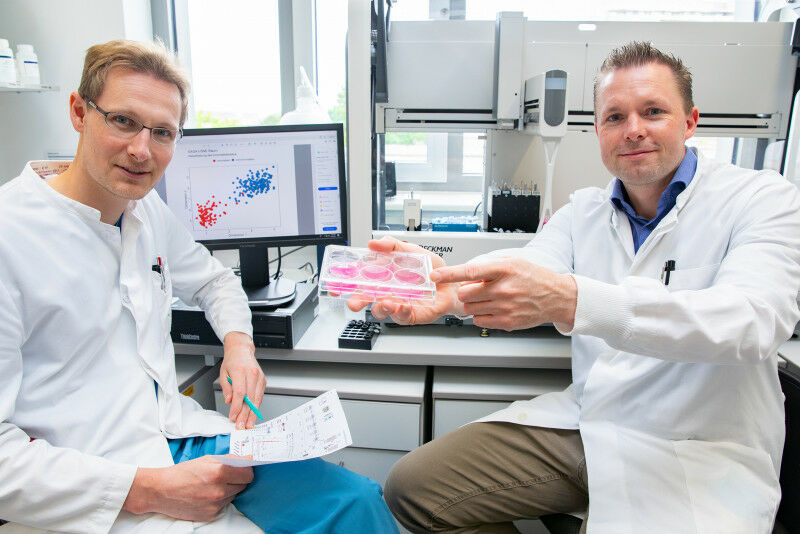
Michael Rothe (right, with a cell culture cultivation dish) and Adrian Schwarzer in front of a pipetting robot for testing gene therapy vectors. The monitor shows a schematic representation of the bioinformatic prediction into cancer-causing (red) and non-cancer-causing (blue) vectors by the SAGA test; Copyright: ’Karin Kaiser / MHH..
Michael Rothe (right, with a cell culture cultivation dish) and Adrian Schwarzer in front of a pipetting robot for testing gene therapy vectors. The monitor shows a schematic representation of the bioinformatic prediction into cancer-causing ( red ) and non-cancer-causing ( blue ) vectors by the SAGA test; Copyright: 'Karin Kaiser / MHH. SAGA detects tumour potential of viral vectors for blood stem cells When the causes of serious diseases are based on a defective gene, medicine relies on gene therapy. In this strategy, defect-free genes are introduced into the body with the help of certain viruses. In this way, individual forms of congenital blindness, hereditary muscular atrophy or certain diseases of the blood and immune system can already be treated today. However, the viral vectors used as gene shuttles work in different ways. Some simply deliver the intact gene into the cell.
TO READ THIS ARTICLE, CREATE YOUR ACCOUNT
And extend your reading, free of charge and with no commitment.