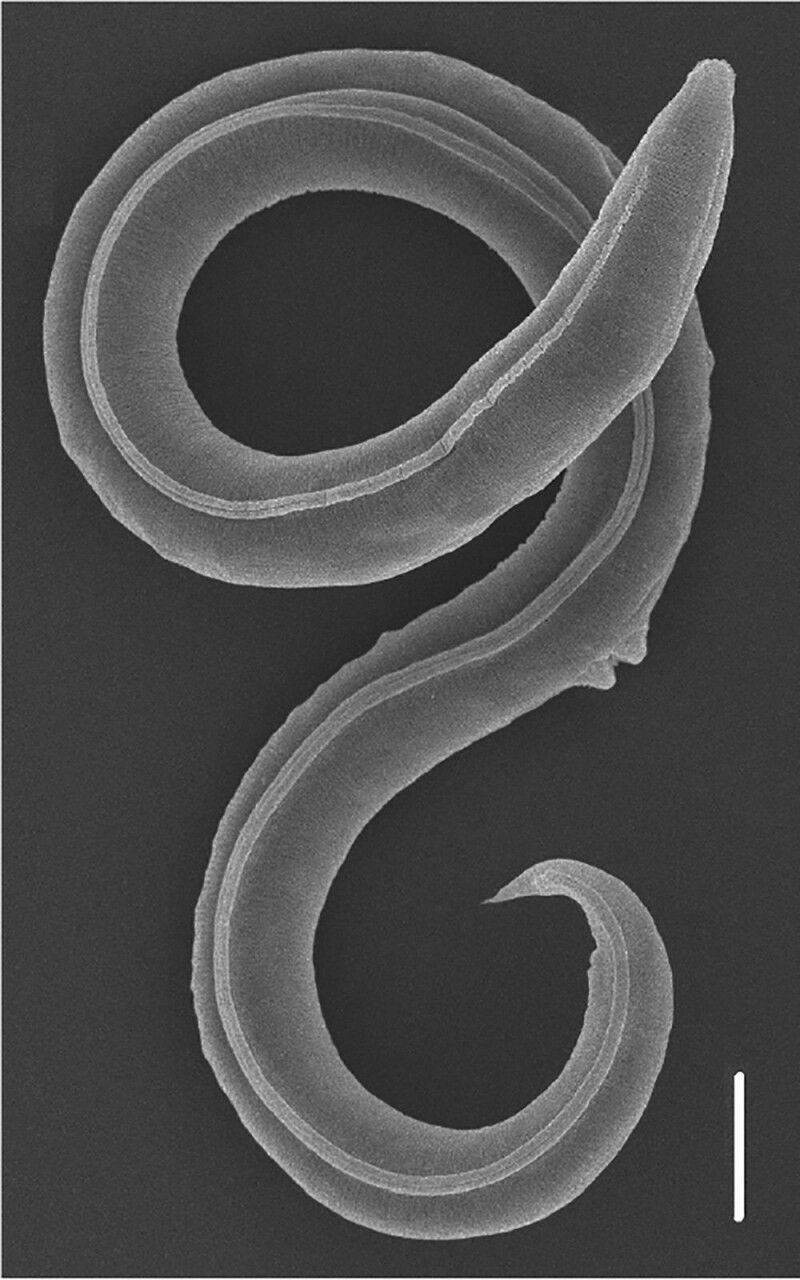
 P. kolymaensis.
A newly discovered nematode species from the Pleistocene shares a molecular toolkit for survival with the nematode Caenorhabditis elegans. P. kolymaensis. Alexei V. Tchesunov and Anastasia Shatilovich / Institute of Physicochemical and Biological Problems in Soil Science RAS - Some organisms, such as tardigrades, rotifers, and nematodes, can survive harsh conditions by entering a dormant state known as "cryptobiosis." In 2018, researchers from the Institute of Physicochemical and Biological Problems in Soil Science RAS in Russia found two roundworms (nematode) species in the Siberian Permafrost. Radiocarbon dating indicated that the nematode individuals have remained in cryptobiosis since the late Pleistocene, about 46,000 years ago. Researchers from the Max Planck Institute of Molecular Cell Biology and Genetics in Dresden, the Center for Systems Biology Dresden, and the Institute of Zoology at the University of Cologne, all located in Germany, used genome sequencing, assembly, and phylogenetic analysis and found that the permafrost nematode belongs to a previously undescribed species, Panagrolaimus kolymaensis . They showed that the biochemical mechanisms employed by Panagrolaimus kolymaensis to survive desiccation and freezing under laboratory conditions are similar to those of a life-cycle stage in the important biological model Caenorhabditis elegans . When Anastasia Shatilovich at the Institute of Physicochemical and Biological Problems in Soil Science RAS in Russia revived two frozen individual nematodes from a fossilized burrow in silt deposits in the Siberian permafrost, she and her colleagues were beyond excited.
UM DIESEN ARTIKEL ZU LESEN, ERSTELLEN SIE IHR KONTO
Und verlängern Sie Ihre Lektüre, kostenlos und unverbindlich.
Ihre Vorteile
- Zugang zu allen Inhalten
- Erhalten Sie Newsmails für Neuigkeiten und Jobs
- Anzeigen veröffentlichen