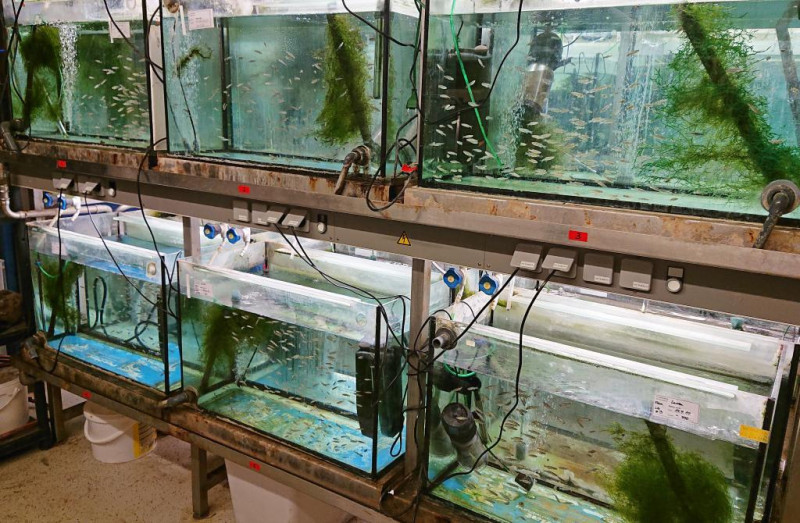
Scientists from Heidelberg University, the University of Tübingen and the Karlsruhe Institute of Technology are collaborating in Effect-Net to investigate the effects of drugs and food additives in aquatic ecosystems. | Susanne Mieck, Heidelberg University
Scientists from Heidelberg University, the University of Tübingen and the Karlsruhe Institute of Technology are collaborating in Effect-Net to investigate the effects of drugs and food additives in aquatic ecosystems. Susanne Mieck, Heidelberg University - Residues of pharmaceuticals in surface waters - in this case an antidiabetic and two antidepressants - also have effects on fish. Drugs for the treatment of depression have particularly strong effects, with fish losing their natural reaction to stress when substance concentration in the water is above a certain level. This is shown by studies carried out as part of the interdisciplinary project "Effect Network in Water Research" (Effect-Net). Scientists from Heidelberg University, the University of Tübingen and the Karlsruhe Institute of Technology (KIT) are collaborating in Effect-Net to investigate the effects of drugs and food additives in aquatic ecosystems. In addition, political scientists are investigating consumer behaviour and the question of whether consumers would perhaps switch to drugs that are more expensive but less harmful to the environment. As documented by behavioural studies with zebrafish and brown trout, antidepressants have a particularly strong effect.
TO READ THIS ARTICLE, CREATE YOUR ACCOUNT
And extend your reading, free of charge and with no commitment.