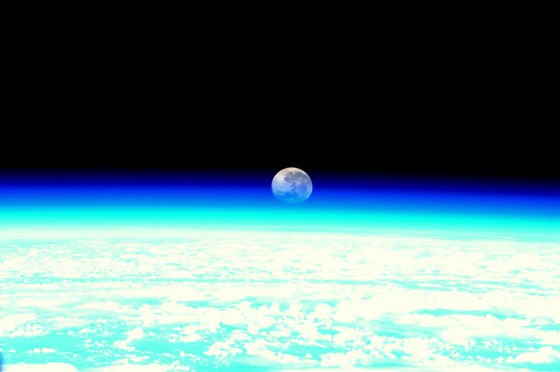
 The setting moon, as seen from the ISS
©
The setting moon, as seen from the ISS
©
Gold and other precious metals appeared on Earth after the formation of the Moon / Planetologists' report published in "Nature" - The history of the Earth is closely linked to that of the Moon, which was formed around 4.5 billion years ago when a planet approximately the size of Mars collided with the proto-Earth. During this event a large part of the Earth melted, and all the elements which tend to bind to metals travelled into the core of the Earth, while the rest remained in the surrounding mantle. As a result, all precious metals should be located in the Earth's core. But where, then, does our gold come from? A common hypothesis is that smaller bodies collided with the Earth after the Moon was formed and after the completion of the formation of the Earth's core, thus enriching the Earth's mantle with precious metals. A team of researchers led by Dr. Thomas Kruijer and Prof. Thorsten Kleine from University of Münster have now, for the first time, found evidence for this hypothesis - as they report in the specialist journal "Nature": they succeeded in demonstrating differences in the tungsten isotope compositions in rocks from the Earth and the Moon. Most of the element tungsten, just like precious metals, is found in the Earth's core. The peculiarity of tungsten is that its isotope composition varies.
TO READ THIS ARTICLE, CREATE YOUR ACCOUNT
And extend your reading, free of charge and with no commitment.
Your Benefits
- Access to all content
- Receive newsmails for news and jobs
- Post ads