







news
University of Tübingen
Results 41 - 60 of 152.
Life Sciences - Computer Science - 11.09.2024

Information in the brain is transmitted via electrical signals between specialized cells called neurons. The activity within a large network of such neurons controls sensations, behavior, and cognition. Scientists have long sought ways to simulate the neural networks in the brain with computers in order to understand how it works.
Environment - 19.08.2024

Baby sea turtles respond even more to fluctuating precipitation than to changes in air temperature during their development in the egg. The effects of precipitation differ depending on the species - or even the population.
Environment - Life Sciences - 16.08.2024

Using the largest dataset of human fossils from Ice Age Europe to date, an international research team shows how prehistoric hunter-gatherers coped with climate change in the period between 47,000 and 7,000 years ago.
Environment - Agronomy & Food Science - 26.07.2024
Most of the glyphosate in our rivers may not come from farming
A research team at the University of Tübingen has found that most glyphosate that ends up in European rivers likely does not come from herbicides, as previously assumed; instead, it may be the result of additives to detergents. For the study, Professor Carolin Huhn of the Institute of Physical and Theoretical Chemistry and colleagues from the Geoand Environmental Center conducted a large meta-analysis on data from European and US water protection authorities.
Environment - Earth Sciences - 04.07.2024

Researchers from the Senckenberg Centre for Human Evolution and Palaeoenvironment (SHEP) at the University of Tübingen and the Senckenberg Natural History Museum in Görlitz have studied the role of the desert grass Stipagrostis sabulicola in the African Namib Desert. In their study, published in the journal Scientific Reports , they show that the plant is able to absorb moisture from fog events and thus forms an essential basis of an - altogether unexpectedly complex - food web in the drought-stricken landscape.
Paleontology - Life Sciences - 07.06.2024

An international team of researchers has discovered a previously unknown ape species in the Hammerschmiede clay pit in southern Germany. Buronius manfredschmidi was found close to the great ape Danuvius guggenmosi , known as "Udo". This was about 12 million years ago the first ape with adaptations for walking upright and made the Hammerschmiede excavation site famous.
History & Archeology - 03.06.2024

A team of archaeologists discovers an almost 1.000-year-old games collection including a well-preserved chessman, gaming pieces and dice. Laboratory analyses show that one party played with red. The laboratory results also allow conclusions to be drawn about the astonishing continuity of the rules of the game.
History & Archeology - 27.05.2024

Although the children of Neanderthals, who lived until around 40,000 years ago, and those of modern humans of the Upper Paleolithic Age 50,000 to 12,000 years ago were probably subjected to comparable stresses, systemic stress peaked at different stages of development. Research into their teeth has revealed that enamel growth reflects stress phases caused by issues such as disease and malnutrition during the early years of life.
Campus - 23.05.2024

In a behavioral experiment crows can learn to produce a set number of calls. This involves them planning in advance: from the sound of the first call in a numerical sequence it is possible to predict how many calls the crows will make. A research team consisting of Dr. Diana A. Liao, Dr. Katharina F. Brecht and assistant professor Lena Veit led by Professor Andreas Nieder from the Institute of Neurobiology at the University of Tübingen has established this.
Life Sciences - Earth Sciences - 15.05.2024

A team of researchers at the Universities of Tübingen and Göttingen has found that certain minerals with characteristic shapes could indicate the activity of bacteria in hydrothermal vents - or black smokers - in the deep ocean several billion years ago. This represents a major step in our understanding of the origin of life.
Paleontology - Environment - 06.05.2024

From today's perspective, they look like a cross between a horse and a gorilla: clawed animals (Chalicotheriidae) had a massive body and a horse-like head; their arms were much longer than their legs and equipped with claws. They belonged to the group of odd-toed ungulates and are thus related to modern rhinoceroses, horses and tapirs.
Life Sciences - Paleontology - 02.04.2024

Whether human or reptile: in the skull of most terrestrial vertebrates there is a gaping hole in the temple; in the case of most reptiles, there are two. Scientists have been looking for explanations for this for 150 years. A team of researchers from the University of Tübingen and Ruhr University Bochum has now shown that the forces acting on the skull change depending on how and where food is held, bitten and chewed in the mouth - and over millions of years, these factors lead to the formation of connections and openings in the skull.
Paleontology - 13.03.2024

An international research team led by Dr. Gabriel S. Ferreira from the Senckenberg Center for Human Evolution and Palaeoenvironment at the University of has described a new species of giant turtle from the late Pleistocene.
Life Sciences - Health - 11.03.2024

Every year, more than 20,000 people in Germany die from blood cancer. In children, blood cancer is even the most common type of cancer. Donations of stem cells from bone marrow or blood increase the chance of survival for people suffering from leukemia or other forms of blood cancer. However, it can take years between the registration of those willing to donate and their actual donation.
Materials Science - 27.02.2024

Early hunter-gatherers from the Middle Stone Age in southern Africa were selecting the most suitable material available for stone tools and spearheads more than 60,000 years ago, according to a study by Dr. Patrick Schmidt from the University of Tübingen's Early Prehistory and Quaternary Ecology section.
History & Archeology - 21.02.2024
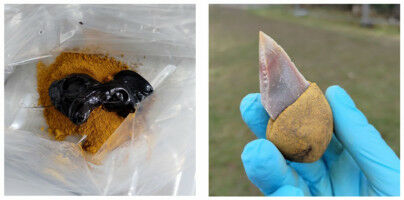
More than 40,000 years ago, early people in what is now France used a multi-component adhesive to make handles for stone tools. They produced a sophisticated mixture of ochre and bitumen, two raw materials that had to be procured from the wider region. This is the earliest discovery of a multi-component adhesive in Europe to date.
Life Sciences - 15.02.2024
Hairy bittercress is one of those plants that hurl their seeds in all directions to spread them effectively. A research team has now discovered that to do this, the plant uses a previously unknown mechanism which makes the seed pods contract and snap open, acting almost like a muscle. Dr. Gabriella Mosca at the University of Tübingen's Center for Plant Molecular Biology was one of the lead authors in this study headed by Dr. Angela Hay from the Max Planck Institute for Plant Breeding Research in Cologne.
Health - Life Sciences - 19.01.2024
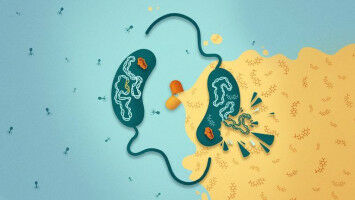
Bacteria have an immune system that protects them against viruses known as bacteriophages. A research team from the Universities of and Würzburg has now shown how this immune system enhances the effect of specific antibiotics against the cholera pathogen Vibrio cholerae . The immune system is the reason why this bacterium is particularly sensitive to one of the oldest known classes of antibiotics - the antifolates.
Life Sciences - Psychology - 05.01.2024

Since their discovery in the 1990s, the head-direction cells in the brain have been referred to as its "internal compass." These cells are activated when the head of an animal or human points in a certain direction, and are thought to be important for spatial orientation and navigation. Now a team of neuroscientists at the University of Tübingen has discovered that head-direction cells in mice do more than this.
Health - Life Sciences - 18.12.2023

Researchers at the University of Tübingen have discovered a novel antibiotic substance from the human nose that can be used against pathogenic bacteria. Named epifadin, the molecule is produced from specific strains of the bacterial species Staphylococcus epidermidis , which occur on the mucous membrane of the inside wall of the nose.


