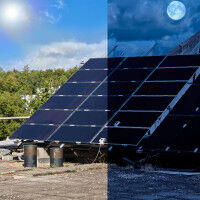
Iron-based redox flow batteries are considered a promising technology for the stationary storage of large quantities of renewable energy - for example in wind or solar parks. Such storage systems are important because renewable energy is not always available when it is needed.
"In simple terms, a redox flow battery can be thought of as a rechargeable fuel cell," explains Marius Engler:
The actual energy storage units are liquid electrolytes that are stored in external tanks. These liquids are pumped through a reaction cell in which chemical reactions take place and electrical energy is stored or released again. Depending on whether the battery is being charged or discharged, these reactions take place in one direction or the other.
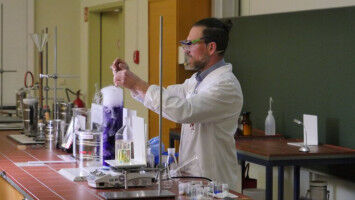
In his master’s thesis in the Renewable Energy Technology degree program, the doctoral candidate at the Electrochemistry and Electroplating Group headed by Prof. Andreas Bund investigated which electrolytes are particularly suitable for making these batteries efficient, stable and long-lasting. To this end, he systematically analyzed their electrochemical and energetic properties and tested a selection of suitable electrolytes for the first time in pilot trials on a test stand.
Together with his colleagues Dr. Michael Stich, Dr. Christoph Baumer and Prof. Andreas Bund, Marius Engler published the data sets on which his research was based in parallel with the publication of a paper "Investigating the Iron Plating and Stripping of Anolytes for All-Iron Redox-Flow Batteries" based on his Master’s thesis. He was supported by Kevin Lindt, Data Steward at TU Ilmenau, and made use of the courses and advice provided by the Thuringian Competence Network for Research Data Management (TKFDM).
The dataset comprises 24 raw data files with the data collected and used for data processing. The folder also contains seven processed data sets that were used to present and analyze the data. Marius Engler:
Since I ’re-applied’ an analysis method for my purposes, I also provided and described a link to the underlying software used for data collection. My aim was to increase the transparency of data acquisition and processing in the spirit of good scientific practice and to facilitate the reproducibility of the results for other research groups.
Marius Engler describes the description of the data sets and processing procedures as time-consuming but worthwhile:
The main difficulty was to process the ’own data repositories’ to the extent that they meet general criteria of readability and processability and can be further used by other researchers, but also to find the layout that meets as many requirements as possible, summarizes everything and yet remains clear. Following this successful ’test run’, we will extend the depth of integration of data management to our group’s day-to-day work in future - also in light of the growing importance of research data management at our university.
After completing his Master’s degree, Marius Engler has been a doctoral candidate since October 2024 and a scholarship holder of the Thuringian Graduate Funding Program at the Electrochemistry and Galvanotechnology Group since September 2025. In doing so, he is continuing his research work on iron redox flow batteries in order to further improve the efficiency and longevity of the battery through targeted electrolyte modifications.
Original publication:
Engler, M., Stich, M., Baumer, C., & Bund, A. (2025). Supplement Data of Anolytes for All-Iron Redox-Flow Batteries [Data set]. In MDPI (Vol. 7, No. 4, pp. 571-583). Zenodo. https://doi.org/10.5281/zenodo.15730784