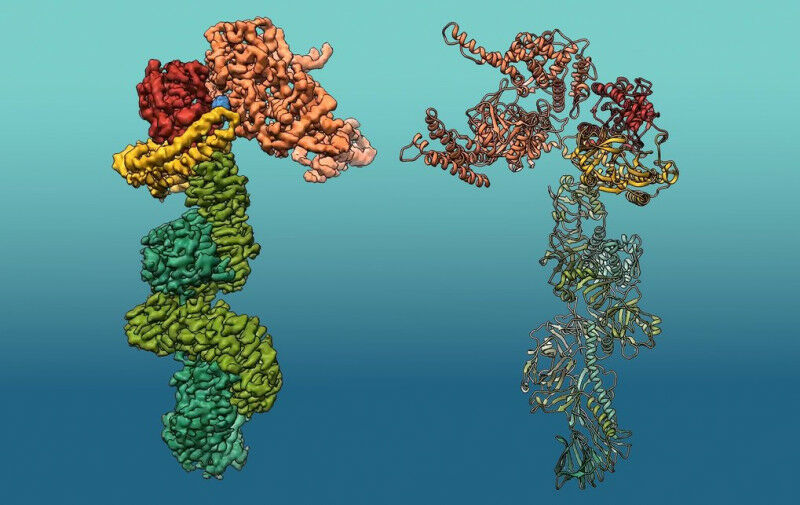
 Mcf1 resembles a seahorse with a head containing several toxic payloads, while the tail region can attach to target cells.
Max Planck researchers from Dortmund reveal the first-ever detailed structure of the bacterial toxin Mcf1. Mcf1 resembles a seahorse with a head containing several toxic payloads, while the tail region can attach to target cells. MPI MOPH - During infection insect-killing bacteria typically release toxins to slay their hosts. The bacterium Photorhabdus luminescens , for example, pumps insect larvae full of the lethal 'Makes caterpillars floppy 1' (Mcf1) toxin, leading them to first become droopy and then dead. However, it has so far been a mystery how Mcf1 unfolds its devastating effect. Researchers at the Max Planck Institute of Molecular Physiology in Dortmund, successfully analyzed the Mcf1 structure, allowing them to propose a molecular mechanism of the toxin's action. Understanding how bacterial toxins perform their deadly task in such detail is very useful for engineering novel biopesticides, thereby reducing the use of barely specific chemical agents with harmful side effects for the ecosystem.
UM DIESEN ARTIKEL ZU LESEN, ERSTELLEN SIE IHR KONTO
Und verlängern Sie Ihre Lektüre, kostenlos und unverbindlich.
Ihre Vorteile
- Zugang zu allen Inhalten
- Erhalten Sie Newsmails für Neuigkeiten und Jobs
- Anzeigen veröffentlichen