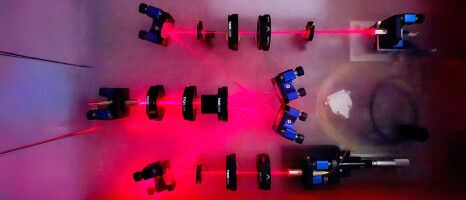
Learning with light: This is what the dynamics of a light wave employed inside a physical self-learning machine could look like. Crucial are both its irregular shape and that its development is reversed exactly from the time of its greatest extent (red).
New physics-based self-learning machines could replace the current artificial neural networks and save energy. Learning with light: This is what the dynamics of a light wave employed inside a physical self-learning machine could look like. Crucial are both its irregular shape and that its development is reversed exactly from the time of its greatest extent ( red ). Florian Marquardt, MPL Artifical intelligence not only affords impressive performance, but also creates significant demand for energy. The more demanding the tasks for which it is trained, the more energy it consumes. Víctor López-Pastor and Florian Marquardt, two scientists at the Max Planck Institute for the Science of Light in Erlangen, Germany, present a method by which artificial intelligence could be trained much more efficiently. Their approach relies on physical processes instead of the digital artificial neural networks currently used.
UM DIESEN ARTIKEL ZU LESEN, ERSTELLEN SIE IHR KONTO
Und verlängern Sie Ihre Lektüre, kostenlos und unverbindlich.
Ihre Vorteile
- Zugang zu allen Inhalten
- Erhalten Sie Newsmails für Neuigkeiten und Jobs
- Anzeigen veröffentlichen