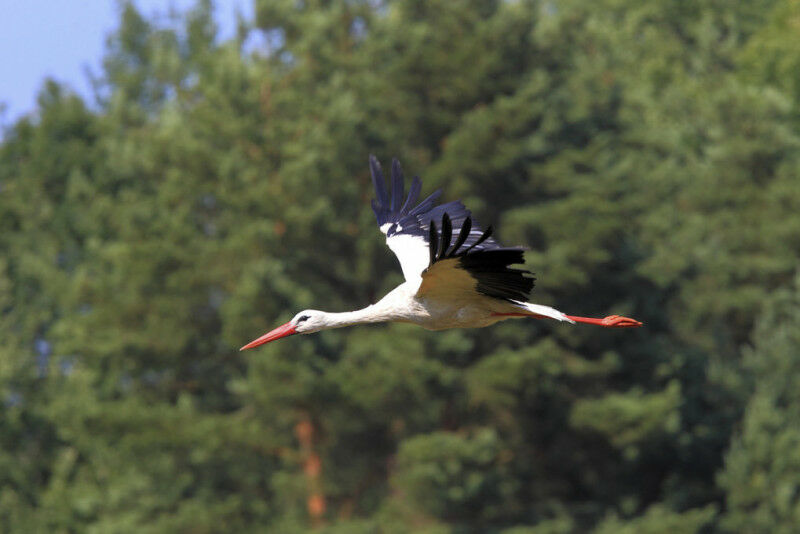
 White storks carrying sensors can monitor on-the-ground conditions in locations along their migratory route.
Carrying small sensors, they could be the most sensitive and informative weather instruments of all. White storks carrying sensors can monitor on-the-ground conditions in locations along their migratory route. MPI of Animal Behavior/ Christian Ziegler The world's scientists rely on an elaborate network of satellites, ocean buoys, weather stations, and balloons to help predict the weather and assess the impact of global climate change across land, air, and sea. But they are overlooking some of the most sensitive and informative instruments of all - the world's animals - argue researchers at Yale's Center for Biodiversity and Global Change and the Max Planck Institute of Animal Behavior. Equipping fish, birds, seals, and terrestrial animals with sophisticated sensors can give researchers localized and timely data on environmental conditions impacted by climate change that current technology cannot, they say. "We can literally turn animals into flying, swimming, and walking weather stations,'' said Diego Ellis Soto, a graduate student at Yale and first author on the paper. "Animals equipped with modern sensors could be seen as the twenty-first century canary in the coal mines." In the paper , the scientists describe the shortcomings of current methods of collecting weather and climate data.
UM DIESEN ARTIKEL ZU LESEN, ERSTELLEN SIE IHR KONTO
Und verlängern Sie Ihre Lektüre, kostenlos und unverbindlich.
Ihre Vorteile
- Zugang zu allen Inhalten
- Erhalten Sie Newsmails für Neuigkeiten und Jobs
- Anzeigen veröffentlichen