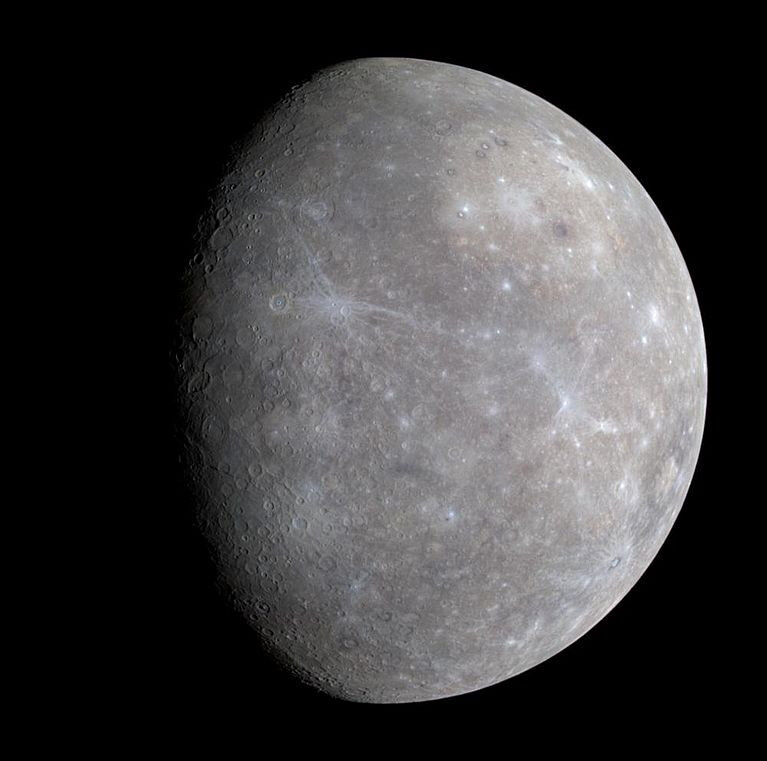
Inconspicuous at first glance: Mercury is the closest planet to the sun in our solar system.
Mercury is not only similar in size to our moon, it is also gray and covered in craters. The special thing about the planet closest to the sun is hidden in its interior: Considering its small size, Mercury has a disproportionately large iron core. A phenomenon that is difficult to explain using traditional theories of planet formation.
An international team of researchers from the Brazilian National Observatory (ON/MCTI), the Université Paris Cité, the School of Engineering and Sciences at UNESP/Guaratinguetá and the University of Tübingen has now developed a new theory on the formation of Mercury based on computer simulations: According to this theory, the planet could have formed from a grazing collision of two protoplanets (mass objects that form the initial phase of planetary evolution). The program to simulate this event was developed by researchers at the University of Tübingen.
Grazing collision instead of impact
Together with Venus, Earth and Mars, Mercury is one of the rocky planets and has a solid surface. Compared to other rocky planets, however, it has several properties that have not yet been fully understood: It has a large solid iron core and a liquid outer core consisting of iron, sulphur and silicates. An iron-poor silicate mantle lies beneath a silicate crust that is only ten kilometers thick and represents an astonishingly thin outermost layer.
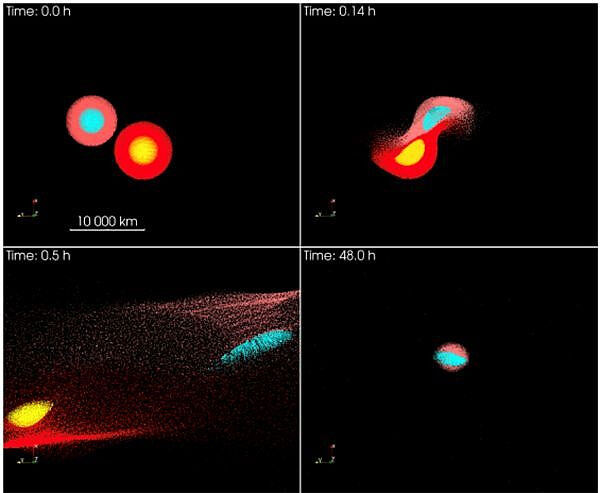
Visualization of the simulation: The time intervals between the snapshots are indicated in the upper left corners. The proto-Mercury is represented by a pink-colored mantle material and a turquoise-colored core. To explain this unusual composition, it was assumed that Mercury’s current shape was created by the violent impact of a smaller celestial body. However, collisions of this kind are extremely rare. Dr. Fernando Roig, Deputy Director of the ON/MCTI, and Patrick Oliveira Franco from the Université Paris Cité were able to prove with the help of new hydrodynamic simulations that the planet’s anomalous structure may be due to a much more frequent event: a gigantic grazing collision between two protoplanets of similar size in the early solar system.
Using high-performance computers to find the origin of a planet
In the simulation, the researchers varied the impact angle and the speed of the collisions. They found that impact conditions in which the collision was just strong enough to separate most of the mantle produced a body with Mercury’s characteristically small size and metal-rich interior. "The work reinforces the idea that giant impacts are not only part of planet formation - they could even be the main factor that shaped the final structure of the rocky planets in the solar system," says lead author The grazing collision was simulated with a special computer program developed in the Computational Physics department at the Institute of Astronomy and Astrophysics at the University of Tübingen by Christoph Schäfer together with postdoc Christoph Burger. the computer program uses special graphics cards for the calculation. Modern high-performance computing architectures such as those we have available here in Tübingen for our research make the development and use of our program code possible in the first place. Simulations that used to take months are now possible in just a few days," says Christoph Schäfer. "Our colleagues were able to simulate many different parameters in a short space of time with the help of our code."
Publication:
Patrick Franco, Fernando Roig, Othon C. Winter, Rafael Sfair, Christoph Burger & Christoph Schäfer: Formation of Mercury by a grazing giant collision involving similar-mass bodies. Nature Astronomy, https://doi.org/10.1038/s41550-025-02582-y