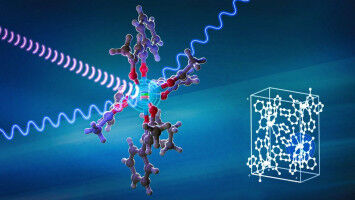
Ultra-fast citation of the spin moments compared to orbital moments in 4f ferromagnets Image Credit: A. Donges
Ultra-fast citation of the spin moments compared to orbital moments in 4f ferromagnets Image Credit: A. Donges - Physicists investigate the magnetization dynamic of rare earths with regard to their suitability for use in ultrafast data storage No 167/2020 from Sep 24, 2020 Researchers from Freie Universität Berlin and universities in Prague, Uppsala, and Konstanz contribute to basic understanding of the magnetization dynamic of a material with the high magnetic anisotropy that is decisive for digital data storage. Along with physicist Professor Ulrich Nowak from the University of Konstanz, the research team used elaborate experiments and computer simulations to compare the rare earths gadolinium (Gd) and terbium (Tb). They were able to uncover a new mechanism that causes demagnetization within a picosecond and could be used to switch a bit. This is a thousand times faster than current hard drives. The findings were achieved within the framework of the Transregio Collaborative Research Center 227 of Freie Universität Berlin and the Martin Luther University of Halle-Wittenberg funded by the German Research Foundation. The findings were published in the journal Science Advances (DOI: 10.1126/sciadv.abb1601 ). The rare earth metals are not actually as "rare" as the name would suggest, and they have very special properties, says Professor Martin Weinelt from the Department of Physics at Freie Universität Berlin and a co-author of the study. For example, mixing rare earths in an alloy with iron and cobalt makes it possible to switch this metal's magnetization using a single laser pulse.
TO READ THIS ARTICLE, CREATE YOUR ACCOUNT
And extend your reading, free of charge and with no commitment.