Searching for a Second Earth? Twenty-Six Cameras Scanning the Sky
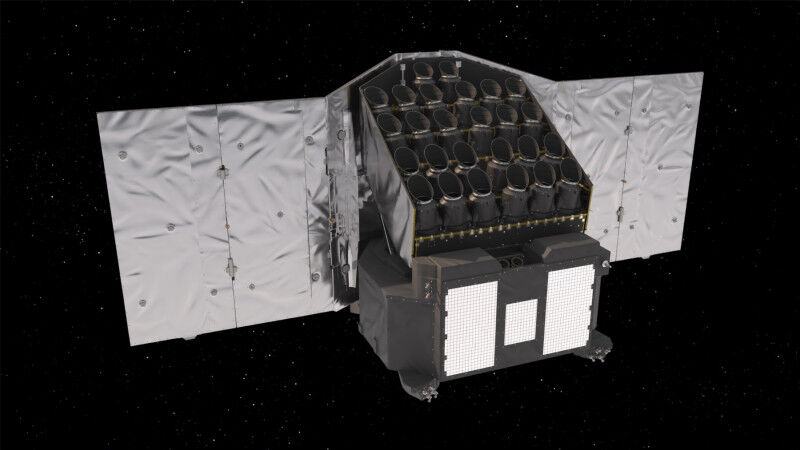
Are there planets similar to Earth? Do they orbit Sun-like stars? How have planet systems formed and how do they develop? To answer these questions, the European space mission PLATO (PLAnetary Transits and Oscillations of stars) will launch at the end of 2026 and will begin searching for exoplanets from 2027. Its focus is on planets similar to Earth in size and distance from their star - potentially habitable worlds. No such planet has yet been verified with certainty.The PLATO telescope will use the transit method to search for planets: When a planet passes in front of its star, it causes a tiny but measurable dimming. PLATO’s twenty-six high-precision cameras will be able to detect these dips in brightness as it scours over 250,000 stars for signs of planets. The mission also has the technology to determine the mass, radius, and age of the observed planets with the highest accuracy.
Successful Preparations: Another Milestone Reached
The PLATO satellite is made up of two components: the so-called payload that contains the twenty-six cameras and the service module that houses the propulsion unit and the systems for communicating with Earth. Both parts were first built and tested separately, and now the modules have been successfully integrated and extensively validated at the OHB System AG facility in Oberpfaffenhofen."Joining payload and service module is an important step for the whole mission," Professor Rauer, the mission’s scientific lead, emphasizes. "The complexity lies not least in the fact that - unlike for many other space telescopes - there was not only one flight model of a telescope camera that needed to be built and tested with great effort, but a series of twenty-six cameras in total."
International Cooperation with Expertise from Germany
The PLATO mission is an ESA satellite mission in cooperation with the PLATO Mission Consortium , which consists of more than one hundred universities and research centers in Europe as well as individual members worldwide and has numerous partners in industry. The consortium is building the scientific payload and is headed by Professor Heike Rauer, who works at Freie Universität Berlin’s Institute of Geological Sciences and the German Aerospace Center (DLR). Members of the Planetary Sciences and Remote Sensing Group at Freie Universität Berlin are contributing significantly to the preparation of the technical and scientific data analysis. The spacecraft carrying the payload is being built and assembled by the industrial PLATO Core Team led by OHB System AG together with Thales Alenia Space and Beyond Gravity."This mission demonstrates the effectiveness of European and international research when many partners work toward a shared objective," emphasizes Rauer. "PLATO has the potential to fundamentally change our understanding of planetary systems and especially planets similar to Earth."
The Latin words veritas, justitia, and libertas, which frame the seal of Freie Universität Berlin, stand for the values that have defined the academic ethos of Freie Universität since its founding in December 1948.