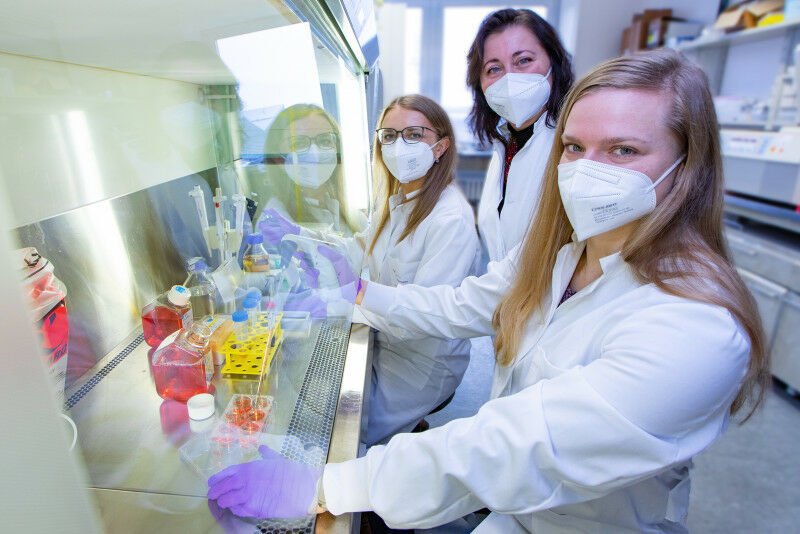
Inga Hochnadel (left), Tetyana Yevsa (centre), Lisa Hönicke (right) in the laboratory; Copyright: Karin Kaiser/ MHH.
Inga Hochnadel ( left ), Tetyana Yevsa ( centre ), Lisa Hönicke ( right ) in the laboratory; Copyright: Karin Kaiser/ MHH. Joint study by MHH and HZI: vaccine proves safe and effective against liver fibrosis and liver cancer Liver cancer is the third most common cause of cancer-related deaths worldwide. So far, the treatment options for two types of liver cancer, hepatocellular carcinoma (HCC) and cholangiocarcinoma (CCA), have been inadequate, while the number of new cases has been rising. A study by researchers at the Hannover Medical School (MHH) and the Helmholtz Centre for Infection Research (HZI) now offers hope. A vaccine based on a highly attenuated infectious agent called Listeria monocytogenes proved to be safe and effective protection in premalignant and malignant liver diseases in preclinical mouse models. "Our Listeria-based vaccine delivers tumour-specific antigens while rapidly and efficiently activating an immune response that actively targets the liver tumour. As a result, the activated immune system keeps the growth of the liver tumour under control," explains Dr Tetyana Yevsa, coordinator of the study and head of the research group in the Department of Gastroenterology, Hepatology and Endocrinology at MHH.
TO READ THIS ARTICLE, CREATE YOUR ACCOUNT
And extend your reading, free of charge and with no commitment.