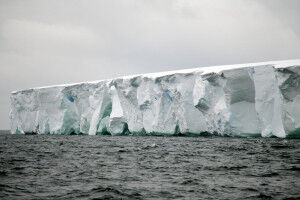
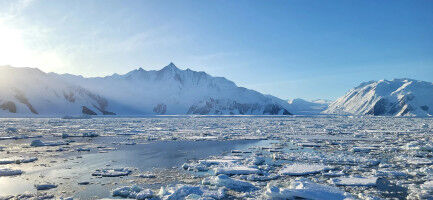
Iceberg armadas and altered river courses caused parts of the northern hemisphere to cool rapidly on several occasions
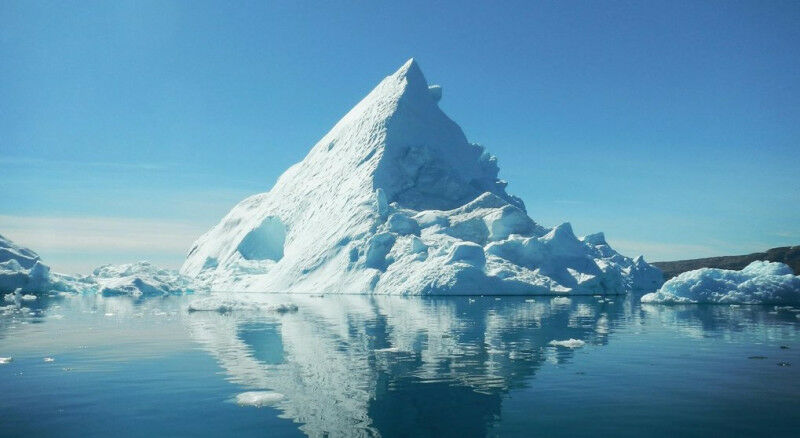
- Abrupt climate changes: From the peak of the last ice age to the Holocene, the North Atlantic and neighboring regions cooled rapidly again and again, temporarily.
- Revealing model simulations: Between 20,000 and 13,000 years ago, ice masses breaking off from the ice sheets of the northern hemisphere enriched the North Atlantic with fresh water and weakened the Atlantic overturning circulation (Amoc), which transports heat from the tropics to the north.
- Other mechanisms of Amoc weakening: Between 13,000 years ago and the Holocene, changes in river courses and ocean passages, which opened up due to the loss of sea ice, apparently led to repeated cooling.
Until man-made global warming, the climate in the Holocene was very stable and made the development of human civilization possible in the first place. However, between the peak of the last ice age and the Holocene, humans in the northern hemisphere were repeatedly exposed to major climate changes: Due to rising sea levels, coastlines changed and recurring phases of strong abrupt cooling forced them to adapt. Researchers at the Max Planck Institute for Meteorology have now determined the causes of these strong temperature fluctuations after the peak of the last ice age around 20,000 years ago using a novel coupled climate-ice sheet model.
20,000 years ago, the Earth’s surface was around four to seven degrees colder than it is today. Massive ice sheets covered Greenland, Antarctica, North America and northwest Eurasia. As ice sheets store huge amounts of water, the sea level was around 80 to 100 meters lower than today. The transition from this situation to today’s climate - triggered by changes in the Earth’s orbit and an increase in atmospheric greenhouse gas concentrations - was by no means uniform, as data from ice cores, sediments and various other sources show. This can be explained in part by the complex interplay between different components of the climate system. However, simulating the climate transition while taking this interaction fully into account has so far been an unsolved challenge for modern climate models.
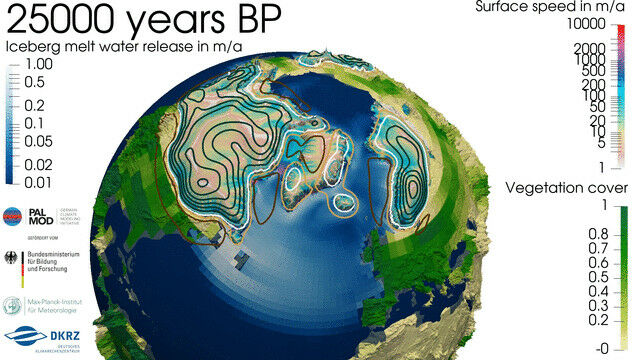
Using a new type of comprehensive model in which the atmosphere, ocean, vegetation, ice sheets and solid earth are dynamically coupled, a team led by researchers from the Max Planck Institute for Meteorology has succeeded for the first time in simulating climate change from the last ice age to the present day using such a complex model. The model, which was developed as part of the PalMod project, takes particular account of dynamic changes in the shape and horizontal extent of ice sheets, changes in the coastline due to fluctuations in sea level, changes in river courses and the formation and distribution of icebergs.
Iceberg armadas and altered river courses
The model simulations show several cooling events during which temperatures over the North Atlantic and neighboring regions fell rapidly. Between 20,000 and 13,000 years ago, these regions cooled several times because the ice sheets in the northern hemisphere became unstable: According to the simulations, huge iceberg armadas broke away from the North American ice sheet and entered the Labrador Sea. These icebergs drifted across the North Atlantic, slowly melting. The meltwater reduced the salinity and density of the surface water and prevented the formation of deep water, weakening the Atlantic Meridional Overturning Circulation (Amoc) - an ocean current that transports heat from lower to higher latitudes.
Between 13,000 years ago today and the Holocene, when the ice sheet over North America was already much smaller, the researchers have identified other mechanisms that can lead to cooling. -An abrupt weakening of the Amoc can also occur when rivers take different paths," says Mikolajewicz. Where exactly meltwater enters the sea can make a big difference, as it can lead to reduced deep water formation and thus to a weakening of the Amoc. In addition, the disappearance of sea ice cover in ocean passages such as the Bering Strait or the Hudson Strait can change the Atlantic overturning circulation and thus the North Atlantic climate.
The study shows that coupled climate-ice sheet simulations offer a way to investigate the mechanisms behind the abrupt climate changes after the last ice age, and that it is important to include the full range of interactions between the atmosphere, ocean,Öland and ice sheets. This will improve the physical understanding of the mechanisms behind abrupt climate changes - not only in the distant past, but also in the future.
Mikolajewicz, U., Kapsch, M.-L., Schannwell, C., Six, K. D., Ziemen, F. A., Bagge, M., Baudouin, J.-P., Erokhina, O., Gayler, V., Klemann, V., Meccia, V. L., Mouchet, A., and Riddick, T.