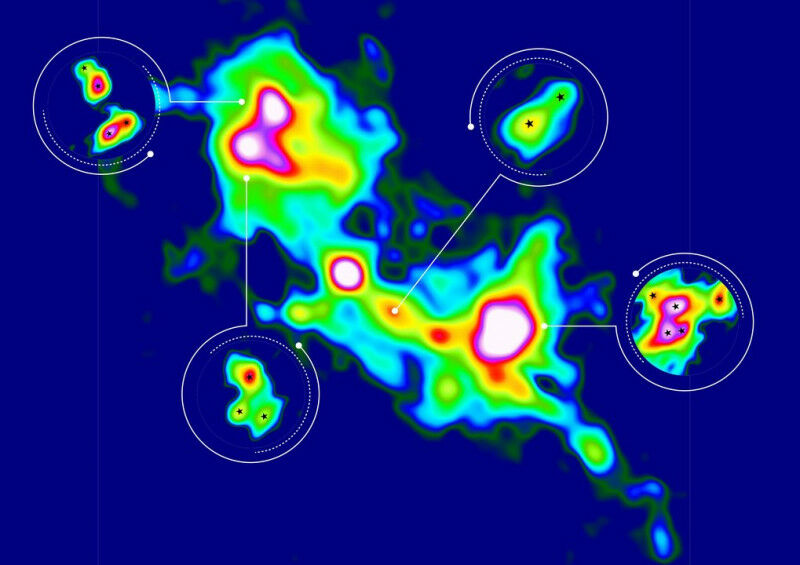
 False-color image of the massive star formation region G333.23-0.06 from data obtained with the ALMA radio observatory. North is to the left. The insets show regions in which Li et al. were able to detect multiple systems of protostars. The star symbols indicate the location of each newly forming stars. The image covers a region 0.62 by 0.78 light-years in size (which on the sky covers a mere 7.5 times 9.5 arc seconds). For comparison: If you look at the sky along an outstretched thumb, it spans a viewing angle of around two degrees. One degree corresponds to 3600 arc seconds.
ALMA Radio observatory observes for the first time how double, triple, quadruple and quintuple star systems form simultaneously in a molecular cloud. False-color image of the massive star formation region G333.23-0.06 from data obtained with the ALMA radio observatory. North is to the left. The insets show regions in which Li et al. were able to detect multiple systems of protostars. The star symbols indicate the location of each newly forming stars. The image covers a region 0.62 by 0.78 light-years in size (which on the sky covers a mere 7.5 times 9.5 arc seconds).
TO READ THIS ARTICLE, CREATE YOUR ACCOUNT
And extend your reading, free of charge and with no commitment.
Your Benefits
- Access to all content
- Receive newsmails for news and jobs
- Post ads