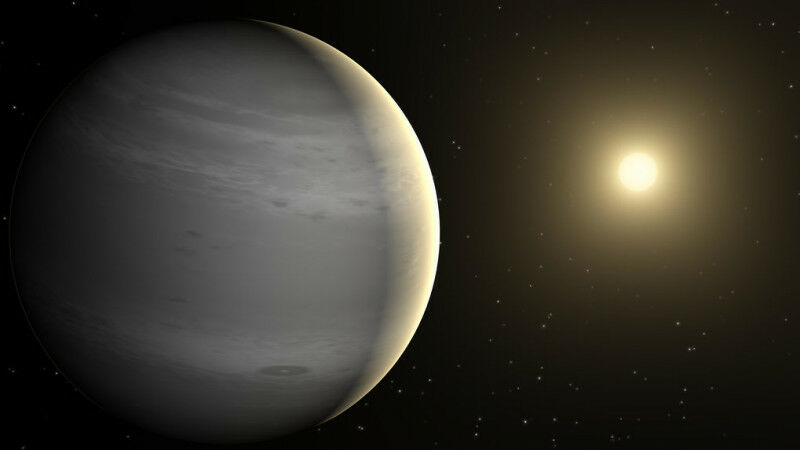
 This artist's impression shows a gas giant exoplanet orbiting a sun-like star, exemplified by Kepler-1625b.
Discovery of giant exomoons around the planets Kepler-1625b and Kepler-1708b called into question. This artist's impression shows a gas giant exoplanet orbiting a sun-like star, exemplified by Kepler-1625b. NASA/JPL-Caltech - Just as it can be assumed that the stars in our Milky Way are orbited by planets, moons around these exoplanets should not be uncommon. This makes it all the more difficult to detect them. So far, only two of the more than 5300 known exoplanets have been found to have moons. A new data analysis now demonstrates that scientific statements are rarely black or white, that behind every result there is a greater or lesser degree of uncertainty and that the path to a statement often resembles a thriller. In observations of the planets Kepler-1625b and Kepler-1708b from the Kepler and Hubble space telescopes, researchers had discovered traces of such moons for the first time.
TO READ THIS ARTICLE, CREATE YOUR ACCOUNT
And extend your reading, free of charge and with no commitment.
Your Benefits
- Access to all content
- Receive newsmails for news and jobs
- Post ads