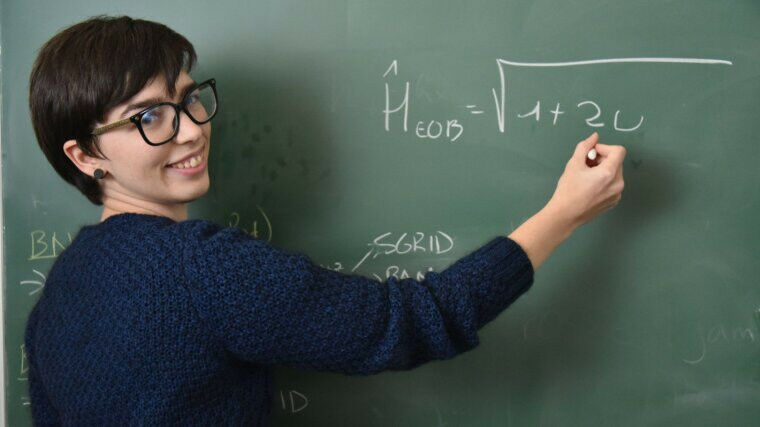
PhD candidate Rossella Gamba is first author of the publication. Image: Anne Günther (University of Jena)
PhD candidate Rossella Gamba is first author of the publication. Image: Anne Günther (University of Jena) Numerical simulation representing the curvature of spacetime during the merger of the two black holes. When black holes collide in the universe, the clash shakes up space and time: the amount of energy released during the merger is so great that it causes space-time to oscillate, similar to waves on the surface of water. These gravitational waves spread out through the entire universe and can still be measured thousands of light years away, as was the case on 21 May 2019, when the two gravitational wave observatories LIGO (USA) and Virgo (Italy) captured such a signal. Named GW190521 after the date of its discovery, the gravitational wave event has since provoked discussion among experts because it differs markedly from previously measured signals. The signal had initially been interpreted to mean that the collision involved two black holes moving in near-circular orbits around each other. " Such binary systems can be created by a number of astrophysical processes, " explains Prof. Sebastiano Bernuzzi, a theoretical physicist from the University of Jena, Germany.
TO READ THIS ARTICLE, CREATE YOUR ACCOUNT
And extend your reading, free of charge and with no commitment.