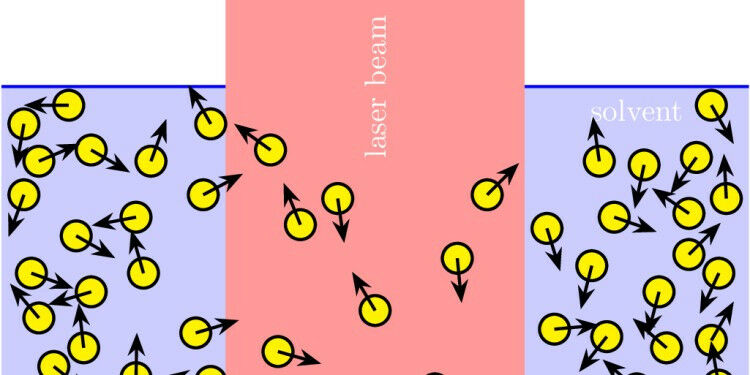
 The density distribution of active particles illuminated by a laser beam is similar to the density distribution of a quantum-mechanical particle in the tunnel effect.
Physicists discover unexpected connection between active particles and quantum-mechanical systems. The density distribution of active particles illuminated by a laser beam is similar to the density distribution of a quantum-mechanical particle in the tunnel effect. M. te Vrugt et al./Nature Research - The study of active particles is one of the fastest-growing areas of physics. With "active particles" physicists refer to objects which move by themselves as a result of internal self-propulsion. These include living things such as bacteria and fish swimming, birds flying or humans walking around - as well as artificial nano-robots which can be inserted into the body to transport medication. What interests the experts in particular is the behaviour of systems involving many active particles so that they can understand, for example, birds swarming, biofilms or gatherings of people. In collaboration with Prof. Eyal Heifetz from the University of Tel Aviv in Israel, physicists Dr. Michael te Vrugt, Tobias Frohoff-Hülsmann, Prof. Uwe Thiele and Prof. Raphael Wittkowski from the Institute of Theoretical Physics at the University of Münster have developed a new model ("active model I+") for the dynamics of systems consisting of many active particles.
TO READ THIS ARTICLE, CREATE YOUR ACCOUNT
And extend your reading, free of charge and with no commitment.
Your Benefits
- Access to all content
- Receive newsmails for news and jobs
- Post ads