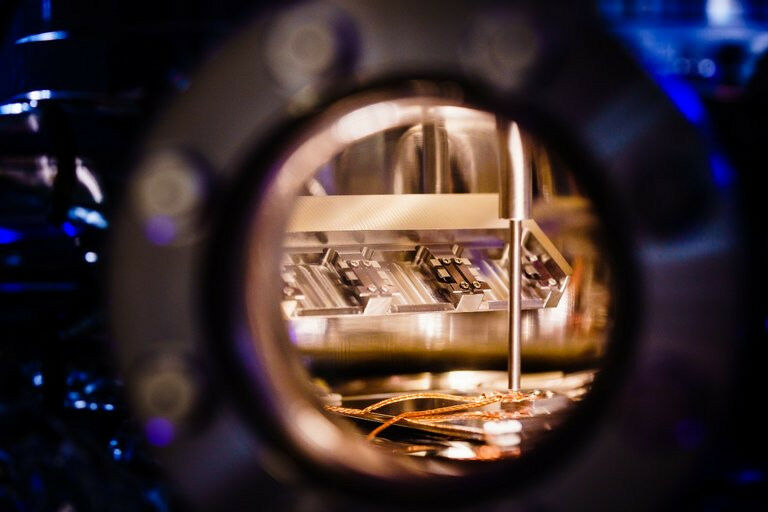
View into the ultra-high vacuum chamber of a scanning tunneling microscope
View into the ultra-high vacuum chamber of a scanning tunneling microscope - Scientists at TU Ilmenau have succeeded in realizing and understanding in detail a molecular magnifying glass for the lattice vibrations of a two-dimensional material. The results of the work, which are the result of many years of intensive joint research with theoretical physicist Mads Brandbyge from TU Denmark, have just been published in Physical Review Letters , the most important journal for physics research. In everyday life, we use a magnifying glass to see objects that are difficult or impossible to see with the naked eye. But how can quantum excitations, i.e. the transmission of minute portions of energy, be made visible in magnified form? Scientists from Ilmenau and Lyngby have now found the answer, scientifically demonstrating how a single molecule amplifies the spectroscopic signatures of graphene phonons, i.e. the vibrational motions of individual carbon atoms in the honeycomb lattice of the two-dimensional material, and how the vibrational signal can be made visible using a scanning tunneling microscope. Unlike light microscopes, a scanning tunneling microscope does not work with optical lenses, but with the quantum mechanical tunnel current. This is injected locally into the sample through the tip of the microscope, crossing a vacuum barrier that cannot be passed by an ordinary current. The local injection and the exponentially sensitive distance dependence of the tunneling current make a scanning tunneling microscope suitable for atomic spatial resolution, i.e., individual atoms of surfaces or molecules deposited on them can be visualized.
TO READ THIS ARTICLE, CREATE YOUR ACCOUNT
And extend your reading, free of charge and with no commitment.