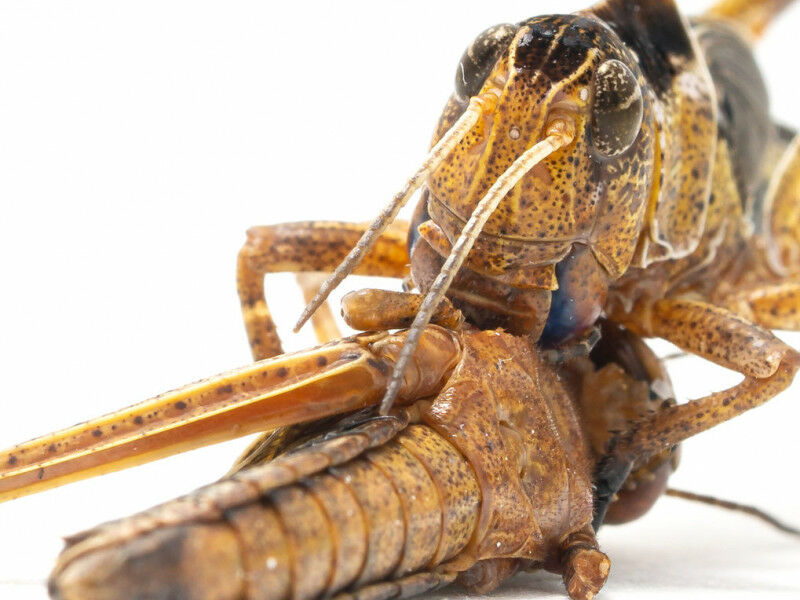
 Cannibalistic feeding attack: A migratory locust Locusta migratoria eats a conspecific. Cannibalism is considered one of the main drivers of the devastating swarming behavior of locusts.
Migratory locusts release a toxic substance to fend off their own conspecifics - . Cannibalistic feeding attack: A migratory locust Locusta migratoria eats a conspecific. Cannibalism is considered one of the main drivers of the devastating swarming behavior of locusts. Benjamin Fabian, MPI für chemische Ökologie - In a new study in the journal Science, researchers from the Max Planck Institute for Chemical Ecology, together with partners from China and the University of Halle, Germany, show that the migratory locust Locusta migratoria produces the compound phenylacetonitrile (PAN) to defend itself against feeding attacks by conspecifics as population density increases. Cannibalism rates increased in locusts that could no longer produce PAN. The researchers also identified the odor receptor for PAN in the locusts. They showed in animals with a PAN receptor that was no longer functional that it is necessary for the perception of PAN and the suppression of cannibalistic behavior.
TO READ THIS ARTICLE, CREATE YOUR ACCOUNT
And extend your reading, free of charge and with no commitment.
Your Benefits
- Access to all content
- Receive newsmails for news and jobs
- Post ads