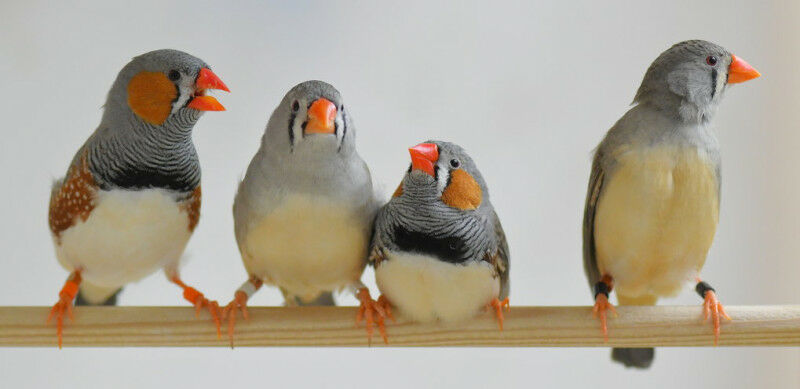
 Using an artificial intelligence technique, researchers discovered dialects in the songs of different zebra finch populations. The photo shows two zebra finch pairs: one pair from a wild-derived populations (the birds in the middle, female on the left, male on the right), and one pair from a domesticated population (male on the left and female on the right). Note that the birds from the domestic population are notably larger.
Using an artificial intelligence technique, researchers discovered dialects in the songs of different zebra finch populations. The photo shows two zebra finch pairs: one pair from a wild-derived populations (the birds in the middle, female on the left, male on the right), and one pair from a domesticated population (male on the left and female on the right). Note that the birds from the domestic population are notably larger. MPI for Biological Intelligence, i.f. Wolfgang Forstmeier - Male zebra finches learn their song by imitating conspecifics. To stand out in the crowd, each male develops its own unique song. Because of this individual-specific song, it was long assumed that dialects do not exist in zebra finches. However, with the help of an artificial intelligence technique, researchers at the Max Planck Institute for Ornithology (Biological Intelligence, in foundation), have now been able to show that the songs of four different zebra finch populations differ systematically. They also discovered that these -cryptic dialects- are decisive for the females' choice of mate. Thus, female zebra finches pay more attention to a cultural trait than to male appearance. To us, bird song may just sound pretty. However, if we want to understand why birds sing, we have to consider that song may have multiple functions. A male's song may serve to repel a male neighbor, or to attract a female. In either case it should be clear from the signal who the sender of the message is. Which species is it, and which individual?
TO READ THIS ARTICLE, CREATE YOUR ACCOUNT
And extend your reading, free of charge and with no commitment.
Your Benefits
- Access to all content
- Receive newsmails for news and jobs
- Post ads