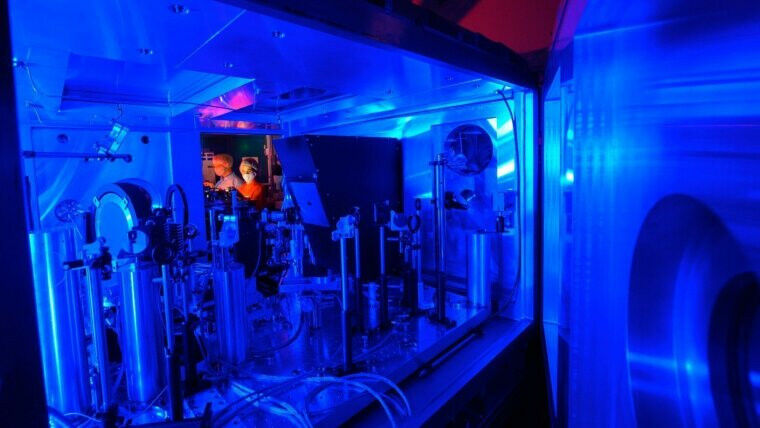
Malte Kaluza (l.) and Dr Yasmina Azamoum are preparing an experiment using the POLARIS laser. Image: Jens Meyer (University of Jena)
Malte Kaluza (l.) and Dr Yasmina Azamoum are preparing an experiment using the POLARIS laser. Image: Jens Meyer (University of Jena) - Proton therapy is a precise and effective treatment for tumours in sensitive areas of the body, such as the brain or the eyes, with the advantage that it spares healthy tissue. In this procedure, protons (positively charged particles) are strongly accelerated and directed with precision into the tumour tissue, which is destroyed in the process. However, this efficient method of treatment has so far required large accelerators, which is why it is only available in major treatment centres. However, it would be possible to generate proton beams with smaller laser systems, by using what is called laser-plasma interaction. Researchers have been working on this for at least two decades, but you will not find such proton lasers in standard hospitals and doctors' surgeries.
TO READ THIS ARTICLE, CREATE YOUR ACCOUNT
And extend your reading, free of charge and with no commitment.