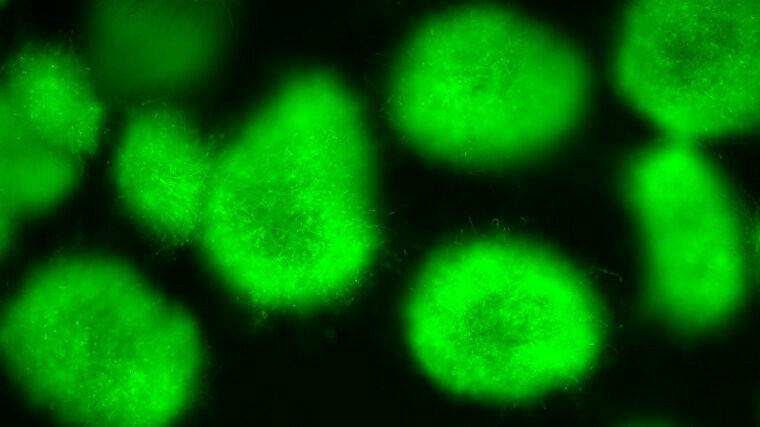
An Aspergillus nidulans reporter strain that produces green fluorescent protein (GFP). Image: Maira Rosin/Leibniz-HKI
An Aspergillus nidulans reporter strain that produces green fluorescent protein (GFP). Image: Maira Rosin/Leibniz-HKI - Bacteria of the genus Streptomyces produce chemical substances called arginoketides, to which many other microorganisms react: Bacteria form biofilms, algae join together to form aggregates, and fungi produce signalling substances that they would not otherwise produce triggering new responses from other organisms. Researchers from the University of Jena and the Leibniz Institute for Natural Product Research and Infection Biology (Leibniz-HKI) show this in a study, in which they investigated various Streptomyces species, the arginoketides they produce and their influence on other soil microorganisms. Even though microorganisms cannot speak, they communicate with each other. To do so, they use chemical substances that other microorganisms understand as signals. "These are relatively small organic compounds, known as natural products," explains Axel Brakhage, head of the study and director of the Leibniz-HKI as well as Professor of Microbiology and Molecular Biology at the Friedrich Schiller University Jena. "Microorganisms produce a variety of such compounds and we are just beginning to understand this language." Bacteria of the genus Streptomyces are apparently particularly important for communication in the soil.
UM DIESEN ARTIKEL ZU LESEN, ERSTELLEN SIE IHR KONTO
Und verlängern Sie Ihre Lektüre, kostenlos und unverbindlich.