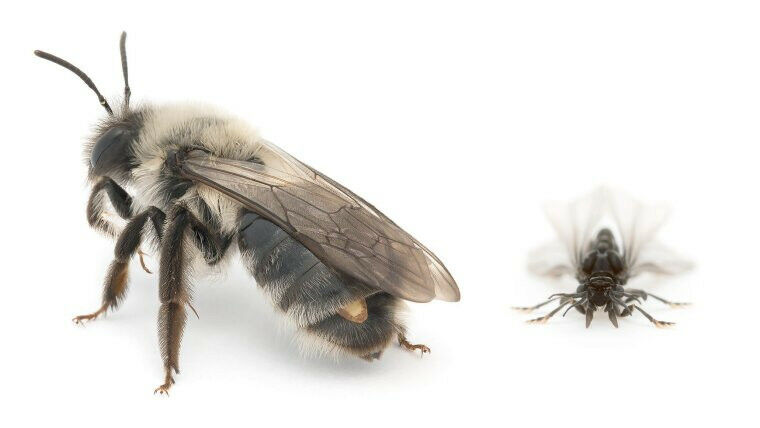
Stylops ovinae: One female protrudes from its host’s abdomen (left); an adult male (right). Image: Hans Pohl/Universität Jena
Stylops ovinae: One female protrudes from its host's abdomen ( left ); an adult male ( right ). Image: Hans Pohl/Universität Jena - Reproduction in the insect order Strepsiptera - also known as twisted-wing parasites - is not for the fainthearted. To inseminate the eggs of its partner, the male partner injures the "neck" of the female with its hook-shaped penis and injects the seminal fluid directly into the body cavity. This traumatic insemination is risky for the female. For example, the injury may result in a loss of body fluid and invading germs may cause infections. However, in the course of evolution, the females of the strepsipteran species Stylops ovinae and Xenos vesparum have become morphologically well adapted to the brutal advances of their partners. This is the conclusion of a research team working at the universities of Jena, Kiel and Freiburg, and the Karlsruhe Institute of Technology, which reports on its findings currently in the scientific journal "PeerJ".
TO READ THIS ARTICLE, CREATE YOUR ACCOUNT
And extend your reading, free of charge and with no commitment.