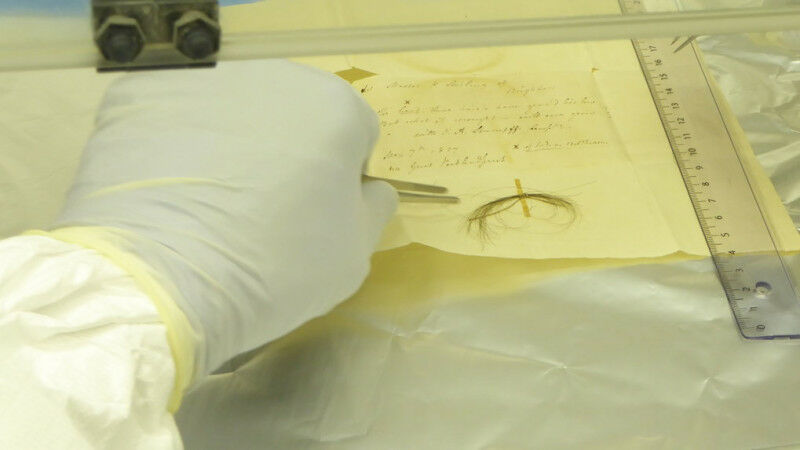
 The ’Stumpff Lock’ emerged as the best-preserved sample from which Beethoven’s whole genome was sequenced.
Scientists have sequenced the composer's genome using five genetically matching hair locks. The 'Stumpff Lock' emerged as the best-preserved sample from which Beethoven's whole genome was sequenced. Anthi Tiliakou - The study shows Beethoven was predisposed to liver disease, and infected with Hepatitis B, which - combined with his alcohol consumption - may have contributed to his death. Furthermore, DNA from modern relatives points to an extramarital 'event' in Beethoven's paternal line. Johannes Krause, director at the Max Planck Institute for Evolutionary Anthropology in Leipzig, Germany, and his team contributed to this study. The research, led by the University of Cambridge, the Beethoven Center San Jose and American Beethoven Society, KU Leuven, FamilyTreeDNA, the University Hospital Bonn and the University of Bonn, the Beethoven-Haus, Bonn, and the Max Planck Institute for Evolutionary Anthropology, uncovers important information about the composer's health and poses new questions about his recent ancestry and cause of death. In 1802, Beethoven asked his doctor to describe his illness and to make this record public.
TO READ THIS ARTICLE, CREATE YOUR ACCOUNT
And extend your reading, free of charge and with no commitment.
Your Benefits
- Access to all content
- Receive newsmails for news and jobs
- Post ads