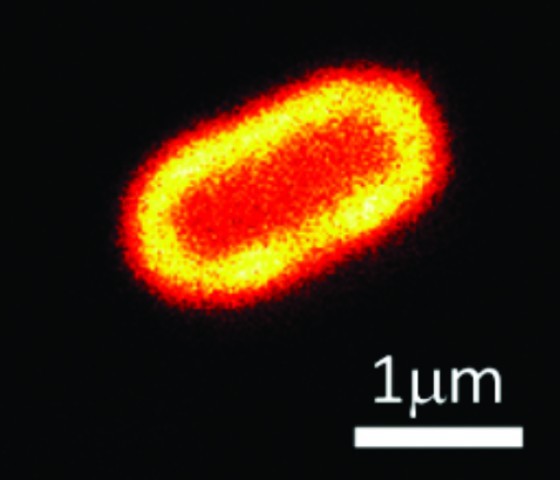
Escherichia coli (gram negative) under the fluorescence microscope. The ?Trojan horses? (yellow) get stuck in the cell wall.
? Wiley-VCH Verlag GmbH and Co. KGaA. Reproduced with permission
Bacterial infections can have serious consequences - for example, when the microorganisms colonize an artificial heart valve or some other prosthesis. There is especially problematic when the bacteria are resistant to several antibiotics. Researchers are therefore looking for new methods of treatment as well as for ways to find centres of infection in the body. So far, some groups have been undertaking research on special sugar molecules with which the bacteria can be marked and thus made visible. What potential this approach has to systematically destroy bacteria at certain places in the body - and what problems arise in the process - is something that a team of German and Italian scientists, led by Münster scientists, has now examined. Scientists use certain complex sugar molecules as Trojan horses to smuggle so-called photoactive labels into the bacteria. These labels can be made visible with light and can then help to localize a centre of infection.
TO READ THIS ARTICLE, CREATE YOUR ACCOUNT
And extend your reading, free of charge and with no commitment.