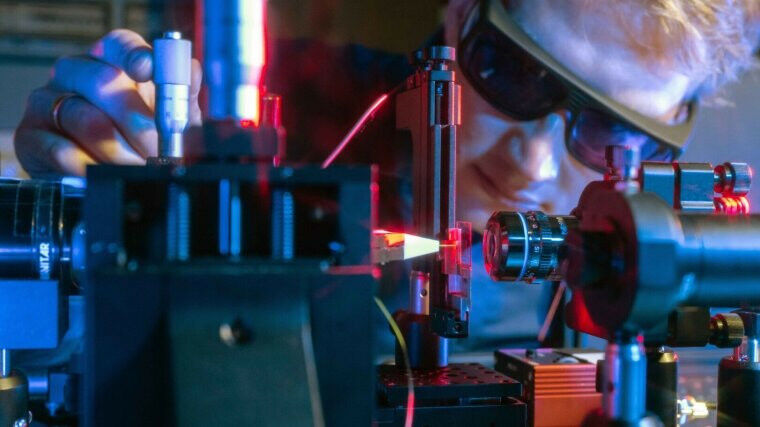
Tobias Vogl investigates single photon sources in 2D materials in an experimental setup. Image: Jens Meyer (University of Jena)
Tobias Vogl investigates single photon sources in 2D materials in an experimental setup. Image: Jens Meyer (University of Jena) - Through steady advances in the development of quantum computers and their ever-improving performance, it will be possible in the future to crack our current encryption processes. To address this challenge, researchers at the Technical University of Munich and the University of Jena are participating in an international research consortium to develop encryption methods that will apply physical laws to prevent the interception of messages. To safeguard communications over long distances, the QUICK³ space mission will deploy satellites. How can it be ensured that data transmitted through the internet can be read only by the intended recipient? At present our data are encrypted with mathematical methods that rely on the idea that the factorization of large numbers is a difficult task. With the increasing power of quantum computers, however, these mathematical codes will probably no longer be secure in the future. Encryption by means of physical laws.
UM DIESEN ARTIKEL ZU LESEN, ERSTELLEN SIE IHR KONTO
Und verlängern Sie Ihre Lektüre, kostenlos und unverbindlich.