










news
University of Tübingen
Results 61 - 80 of 152.
Campus - 30.11.2023
High school students’ academic development linked to achievement emotions over time
School students experience a wide range of achievement emotions during the years they spend attending school. Some of those emotions, such as joy and pride, are positive. Yet students also experience boredom and anger when they find achievement activities too difficult or too easy. These differing emotions are important for adolescents' development trajectories.
Life Sciences - Health - 30.11.2023

In today's medical landscape, antibiotics are pivotal in combatting bacterial infections. These potent compounds, produced by bacteria and fungi, act as natural defenses against microbial attacks. A team of researchers delved into the intricate world of glycopeptide antibiotics - a vital resource in countering drug-resistant pathogens - to uncover their evolutionary origins.
Environment - Earth Sciences - 28.11.2023

In a study published in the journal "Scientific Reports," researchers from the Senckenberg Centre for Human Evolution and Palaeoenvironment (SHEP) at the University of Tübingen show that early humans of the Middle Paleolithic had a more varied diet than previously assumed. The analysis of a site in the Zagros Mountains in Iran reveals that around 81,000 to 45,000 years ago, the local hominins hunted ungulates as well as tortoises and carnivores.
Environment - Earth Sciences - 07.11.2023

Up to now, the results of climate simulations have sometimes contradicted the analysis of climate traces from the past. A team led by the physicist Thomas Laepple from the Alfred Wegener Institute in Potsdam and the climatologist Kira Rehfeld from the University of Tübingen has therefore brought together experts in climate models and climate tracks to clarify how the discrepancies come about.
Economics - Music - 31.10.2023

Music hits that are made available for free by users on YouTube are less in demand on platforms such as Spotify or Apple Music. For the broad mass of lesser-known artists, on the other hand, uploading to YouTube by users can help them gain more attention and thus revenue via more lucrative platforms.
History & Archeology - Astronomy & Space - 16.10.2023

Experts from Egypt and Germany have completed the restoration of the ceiling of the Temple of Esna.
Astronomy & Space - Physics - 11.10.2023

Stars like our sun end their lives as white dwarfs. Some of them are surrounded by a planetary nebula consisting of gas ejected by the dying star shortly before its death. An international research team led by Professor Klaus Werner of the Institute of Astronomy and Astrophysics at the University of has for the first time studied a central star of a planetary nebula located in an open star cluster.
Chemistry - Environment - 04.10.2023

Researchers around the world are working on more efficient methods for producing hydrogen. Hydrogen could make a decisive contribution to reducing the consumption of fossil raw materials, especially if it is produced using renewable energies. Existing technologies for producing climate-neutral hydrogen are still too inefficient or too expensive for broader application.
Life Sciences - Paleontology - 20.09.2023

Today, there exist only three elephant species, in Africa and Asia. Yet the diversity of proboscidean species and their distribution was significantly greater in the Earth's past. Researchers from the University of Tübingen and the Senckenberg Centre for Human Evolution and Palaeoenvironment, working at the Hammerschmiede site in southern Germany, have now described new fossils of early proboscidean species.
Environment - Life Sciences - 07.09.2023

Around 50 million years ago there were extensive, lush deciduous forests in the polar regions of the Arctic, where today there is sparse vegetation. The forests existed due to the conditions in the Eocene - a combination of a greenhouse climate and almost twice the level of carbon dioxide in the atmosphere as there is today.
Health - Life Sciences - 06.09.2023

All over the world, huge quantities of crop protection agents are sprayed to control potato blight ( Phytophthora infestans ). The mechanisms of resistance of potatoes need to be better understood to make growing this crop more sustainable. Researchers of Wageningen University & Research together with their colleagues in Tübingen and Norwich have now taken an important step.
Life Sciences - 10.08.2023
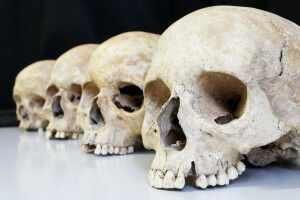
Genetic kinship analyses of human bones reach their limits if the DNA is poorly preserved or if destructive sampling is not possible. New research shows that in such cases, comparisons of the structure and shape of certain parts of the skeleton may also provide detailed information about relationships, and do so non-destructively.
Paleontology - Environment - 08.08.2023

With a shell length of about 100 millimeters, the land-dwelling areolate flat-shelled turtle (Homopus areolatus) is one of today's smallest turtle species. The record at the other end of the scale is held by the leatherback turtle (Dermochelys coriacea), which is common in tropical and subtropical seas and can reach up to two meters in length.
Paleontology - History & Archeology - 04.08.2023

Human history in one click: For the first time, numerous sites relating to the early history of mankind from 3 million to 20,000 years ago can be accessed in a large-scale database. Scientists from the research center ROCEEH ("The Role of Culture in Early Expansions of Humans") have compiled information on 2,400 prehistoric sites and 24,000 assemblages from more than 100 ancient cultures.
History & Archeology - Social Sciences - 31.07.2023

Researchers from the Senckenberg Centre for Human Evolution and Palaeoenvironment at the University of Tübingen and the Brazilian University of São Paulo, together with an international research team led by first author Dr. Tiago Ferraz, compiled the largest genomic dataset from Brazil to demonstrate that sambaqui communities on the southern and southeastern coasts did not represent a genetically homogeneous population.
Paleontology - 13.07.2023

University of Tübingen paleontologists Dr. Márton Rabi and Gustavo Darlim, working with Chulalongkorn University and Department of Mineral Resources of Thailand, have demonstrated that an almost completely fossilized alligator skull found in Thailand belongs to a previously unknown species. The fossil was discovered in 2005 and is at most 230,000 years old.
Environment - Paleontology - 22.06.2023

Wild animals entered into diverse relationships with humans long before the first settlements were established in the Neolithic period around 10,000 years ago. An international study by researchers from the Universities of Tübingen, Helsinki and Aarhus presents new evidence that ravens helped themselves to people's scraps and picked over mammoth carcasses left by human hunters during the Pavlovian culture more than 30,000 years ago in what is now Moravia in the Czech Republic.
History & Archeology - Life Sciences - 15.06.2023

A new study indicates that one of the largest of the indigenous language families in Latin America originated in the sixth century BCE in the basin of the Rio Tapajós and Rio Xingu, near the present-day city of Santarém in the Brazilian state of Pará. There are around fifty languages in the Tupí-Guaraní language family, which gave us words like -jaguar- and -piranha.
Health - 25.05.2023

The feeling that your own actions are controlled by external forces is a common feature in schizophrenia. A research team at the Hertie Institute for Clinical Brain Research, the University of Tübingen and the Center for Mental Health at the Tübingen University Hospitals has now examined this phenomenon of -delusions of control- in more detail.
Paleontology - Life Sciences - 11.05.2023

Schöningen/Tübingen, 05/12/2023. In a study published today in the journal Quaternary Science Reviews, an international research team led by scientists from the University of Tübingen and the Senckenberg Centre for Human Evolution and Palaeoenvironment presents the earliest human footprints known from Germany.


