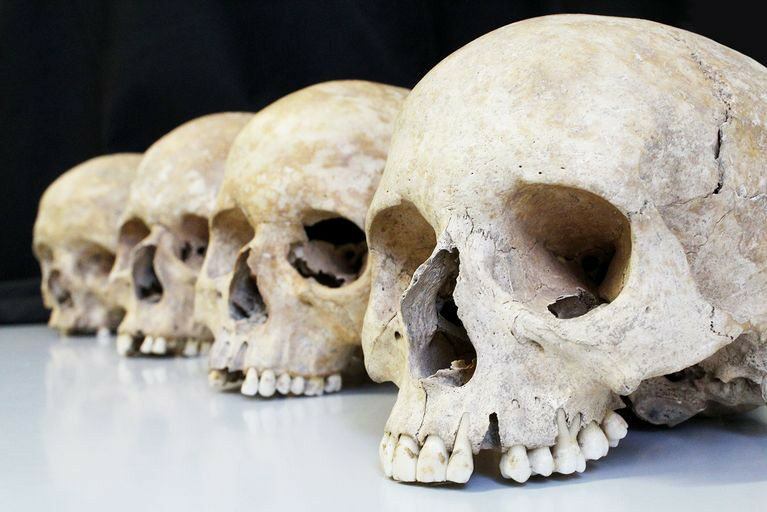
Skulls excavated from an archaeological site.
Skulls excavated from an archaeological site. Genetic kinship analyses of human bones reach their limits if the DNA is poorly preserved or if destructive sampling is not possible. New research shows that in such cases, comparisons of the structure and shape of certain parts of the skeleton may also provide detailed information about relationships, and do so non-destructively. This is the result of a large-scale study by an international research team led by Dr. Hannes Rathmann and Professor Katerina Harvati from the Senckenberg Centre for Human Evolution and Palaeoenvironment and the Institute for Archaeological Sciences at the University of Tübingen. The team analyzed large genetic and skeletal datasets to determine the extent to which human genetic diversity worldwide is reflected in the morphology - i.e, the structure and shape - of skeletal parts. The researchers obtained the best results when comparing certain dental and cranial elements, yet they also found that some worked significantly better than others and this difference is likely the result of how they evolved. This basic research may be used as a reference in future archaeological and forensic investigations to arrive at more robust inferences when DNA analysis is not possible.
UM DIESEN ARTIKEL ZU LESEN, ERSTELLEN SIE IHR KONTO
Und verlängern Sie Ihre Lektüre, kostenlos und unverbindlich.