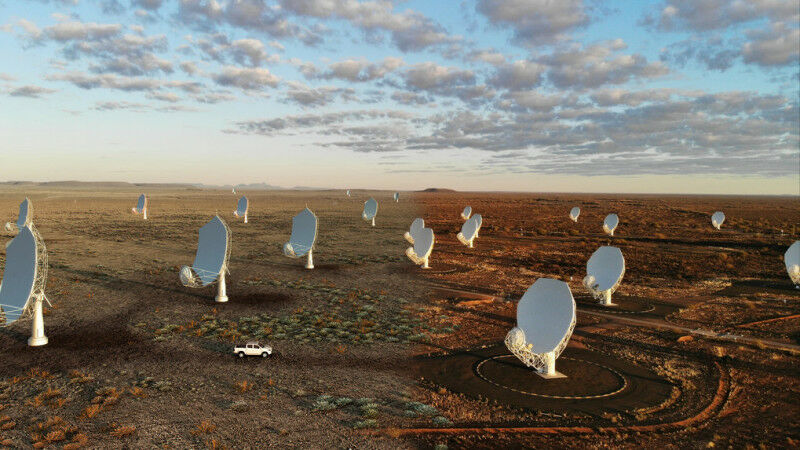
 A composite image of the future SKA-Mid telescope, blending the existing precursor MeerKAT telescope dishes already on site with an artist's impression of the future SKA-Mid dishes.
Astronomers simulate physical processes in the interstellar medium of galaxies at "Cosmic Noon" for future SKAO observations. A composite image of the future SKA-Mid telescope, blending the existing precursor MeerKAT telescope dishes already on site with an artist's impression of the future SKA-Mid dishes. SKAO - An international team of researchers has demonstrated that the Square Kilometre Array Observatory (SKAO) is capable of detecting radio emissions from normal spiral galaxies in the early universe. The SKAO, whose construction began this year, will soon be the largest radio telescope in the world. The astronomers, who are part of the SKAO's "Extragalactic Continuum" working group, are looking for a way to study a cosmic era in which star-forming activity suddenly decreased after an epoch known as "Cosmic Noon". To this end, they simulated the physical properties of the interstellar medium of galaxies similar to the Triangulum Galaxy (M 33) and the Whirlpool Galaxy (M 51) in an early age of the Universe. The results show that potential surveys should be sensitive enough to detect galaxies already in SKAO's first deployment phase.
TO READ THIS ARTICLE, CREATE YOUR ACCOUNT
And extend your reading, free of charge and with no commitment.
Your Benefits
- Access to all content
- Receive newsmails for news and jobs
- Post ads