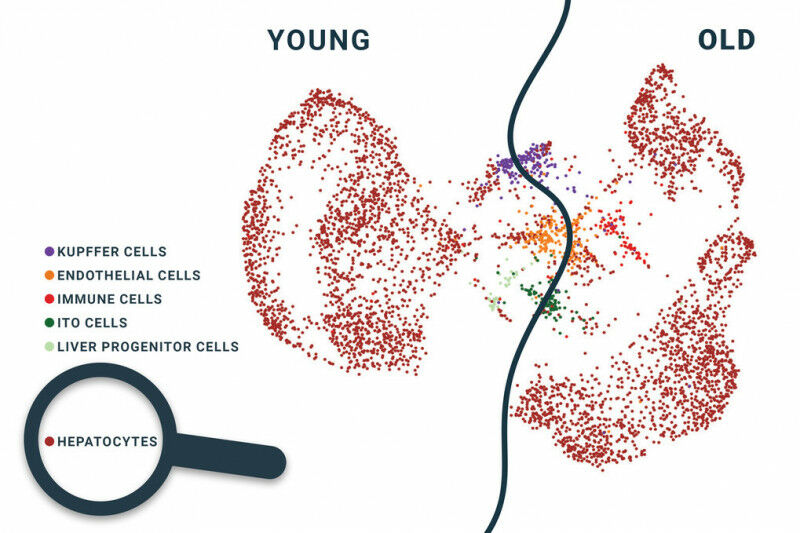
 The epigenome of hepatocytes changes with increasing age. The figure shows a graphical representation of epigenetic measurement data. The further apart two points are, the more different is the epigenome of the cells.
The epigenome of hepatocytes changes with increasing age. The figure shows a graphical representation of epigenetic measurement data. The further apart two points are, the more different is the epigenome of the cells. Max Planck Institute for Biology of Ageing / P. Tessarz & K. Link - Looking around us, we can see that people age at different rates. But what about inside? Do all cells age in the same way? And does the location of a cell in the organ make a difference to the ageing process? Researchers at the Max Planck Institute for Biology of Ageing in Cologne and CECAD Excellence Cluster for Ageing Research have now shown in the liver of mice that liver cells age differently depending on where they are located in the organ. The location of the liver cells has a strong influence on the ageing process. In the region of the liver where the liver cells use oxygen for energy production in their mitochondria, this process deteriorates significantly with age.
TO READ THIS ARTICLE, CREATE YOUR ACCOUNT
And extend your reading, free of charge and with no commitment.
Your Benefits
- Access to all content
- Receive newsmails for news and jobs
- Post ads