


news 2020
« BACK
 MEET - Publication galvanic corrosion
 Movies of nano-tornadoes
 Nano-scientists get new large-scale equipment
 A new lightsource for the chip industry
 Activating palladium catalysis by light: teaching an old transition metal new tricks
 Strange metal behavior in a pure ferromagnetic Kondo lattice
 A real alternative to crude oil
Materials Science
Results 21 - 29 of 29.
Physics - Materials Science - 17.06.2020
A fresh twist in chiral topology
Electrons in "chiral crystals", solid-state materials with definite "handedness", can behave in unexpected ways. An interdisciplinary team from research institutions in Germany and China has realized now a theoretically predicted peculiar electronic state in a chiral compound, PtGa, from the class of topological materials.
Materials Science - Physics - 28.04.2020
Three Research Groups, Two Kinds of Electronic Properties, One Material
An outstanding collaboration combines materials science, experimental and theoretical physics. The work paves the way to new designed materials that combine in them multiple electrical functionalities. This is the story of a unique material - made of a single compound, it conducts electrons in different ways on its different surfaces and doesn't conduct at all in its middle.
Chemistry - Materials Science - 27.04.2020
In addition to high purchase costs and the still underdeveloped charging infrastructure, the limited range is one of the biggest obstacles to switching to electric vehicles. Industry and science are therefore working intensively on developing batteries with a higher energy density and making them suitable for series production.
Physics - Materials Science - 23.04.2020
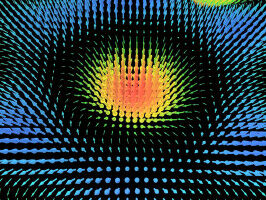
The destructive force of a tornado occurs due to the extremely high rotational speeds in its center, which is called "vortex". Surprisingly, similar effects as in such storms are predicted for light that travels along an atomically smooth gold surface. This light can exhibit angular momentum and vortices.
Physics - Materials Science - 14.04.2020
Production of minute structures with gold and silicon ions / 840,000 euros from the German Research Foundation and the state of North Rhine-Westphalia Investigating and developing nanosystems - i.e. structures which are a thousand times smaller than the diameter of a human hair - is something which occupies researchers collaborating from a variety of disciplines at the University of Münster.
Physics - Materials Science - 08.04.2020
Photonic chips made possible by light-emitting silicon-germanium alloys For the past 50 years, researchers around the globe have been looking for a way to make lasers with silicon or germanium. A team from the Technical University of Eindhoven (TU/e) and the Technical University of Munich (TUM) has now succeeded in developing a light-emitting, silicon-germanium alloy.
Materials Science - Physics - 24.03.2020
In the production of compounds, chemists have the fundamental goal of finding strategies that are most selective and avoid waste products. Breakthroughs in this area serve, among other things, to drive industrial innovation and drug development. In this context, allylic substitution reactions using catalysts made of so-called transition metals have already led to significant advances in science.
Physics - Materials Science - 05.03.2020
In the quest to harness quantum mechanics for new kinds of materials and new kinds of technologies, physicists are turning to the study of 'quantum materials' where the effects of quantum mechanics give rise to new forms of collective behavior. Normal metals, such as copper, gold or aluminum are well understood in terms of the quantum mechanics of individual electrons, and their resistivity depends linearly on temperature due to scattering of electrons by the vibrations of the lattice of atoms.
Chemistry - Materials Science - 27.01.2020
The synthesis of bio-based high-performance polyamide from biogenic residues A research team from the Fraunhofer Society and the Technical University of Munich (TUM) led by chemist Volker Sieber has developed a new polyamide family which can be produced from a byproduct of cellulose production - a successful example for a more sustainable economy with bio-based materials.


