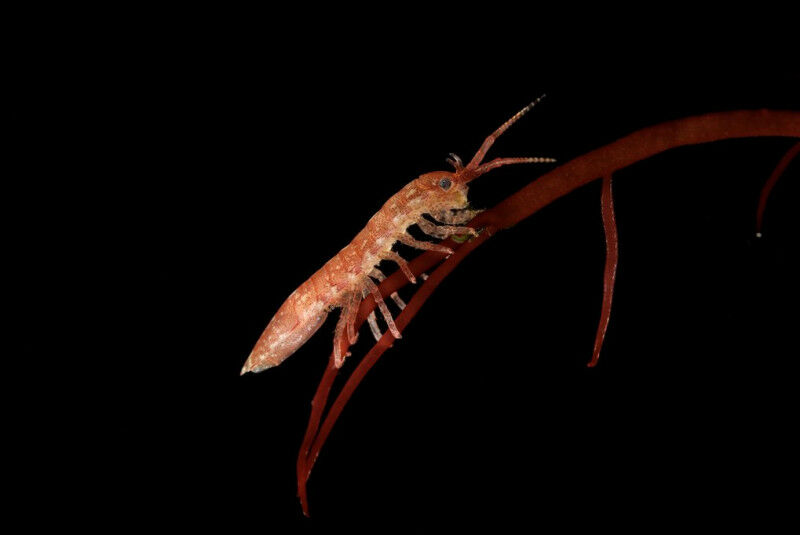
 The marine isopod Idotea balthica © Wilfried Thomas, Station Biologique de Roscoff
Bee of the sea: A small marine isopod aids in pollinating red algae. The marine isopod Idotea balthica © Wilfried Thomas, Station Biologique de Roscoff (SBR) - Until recently, pollination was thought to be exclusive to land plants. An international team of researchers has now discovered that small crustaceans improve the reproduction rate of red algae by transporting the sperm from the male to the female algae. Their results suggest that animals have had a role in fertilization of other species for much longer than previously believed. Flowers and numerous other land plants rely on animals for fertilization; bees and hummingbirds, even bats and lizards carry pollen from a male to a female plant. In contrast, until recently, it was consensus that marine algae do not receive such animal help. An international research team lead by Myriam Valero who, based at the Station Biologique de Roscoff (CNRS, Sorbonne Université, Pontificia Catolica Universidad de Chile and Universidad Austral de Chile), France, now overturned this long-held belief: they showed that the small crustacean Idotea balthica helps pollinate the red alga Gracilaria gracilis.
TO READ THIS ARTICLE, CREATE YOUR ACCOUNT
And extend your reading, free of charge and with no commitment.
Your Benefits
- Access to all content
- Receive newsmails for news and jobs
- Post ads