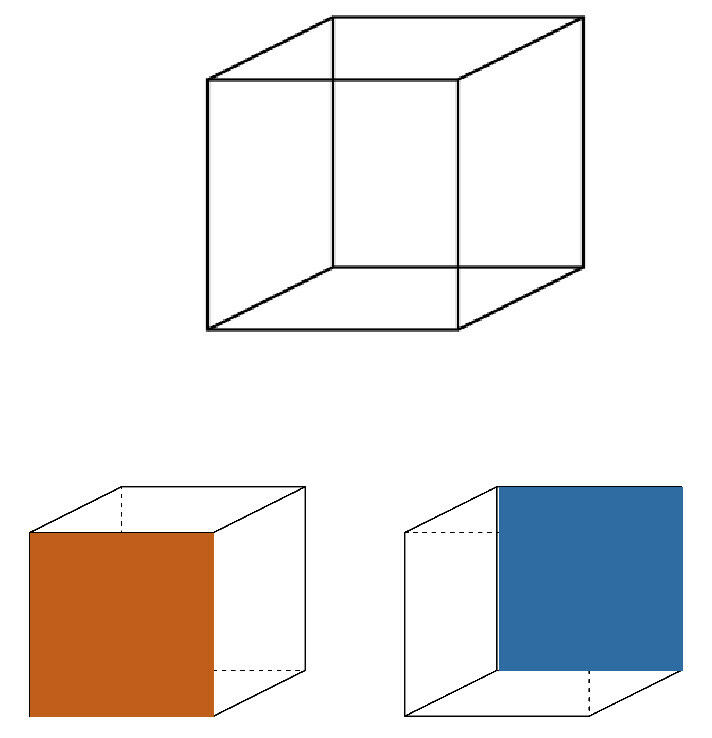
The bi-static figure of the Necker cube can be perceived as pointing left or right.
The bi-static figure of the Necker cube can be perceived as pointing left or right. Although visual perception might seem as easy as just opening our eyes and reporting what is out there, the underlying computations are surprisingly complex. One of the more revealing ways to study these computations is by using inputs that are ambiguous or even impossible under normal circumstances (for instance with radically different pictures seen by the two eyes). Faced with these unreasonable inputs, the brain tends to switch between potential interpretations - where the switching (known as perceptual multistability) obeys some striking rules. Neuroscientists from the Max Planck Institute for Biological Cybernetics in Tübingen and the University of Tübingen have assessed a broad literature on aspects of perceptual multistability, suggesting in a paper published in Neuron. They state that it is appropriate to consider switches as internal actions whose choices are determined by forms of internal value (e.g., emotional content of the image). Max Planck and University of Tübingen scientists Shervin Safavi and Peter Dayan draw on centuries of empirical research and reflection in this field, providing computational and algorithmic interpretations.
TO READ THIS ARTICLE, CREATE YOUR ACCOUNT
And extend your reading, free of charge and with no commitment.