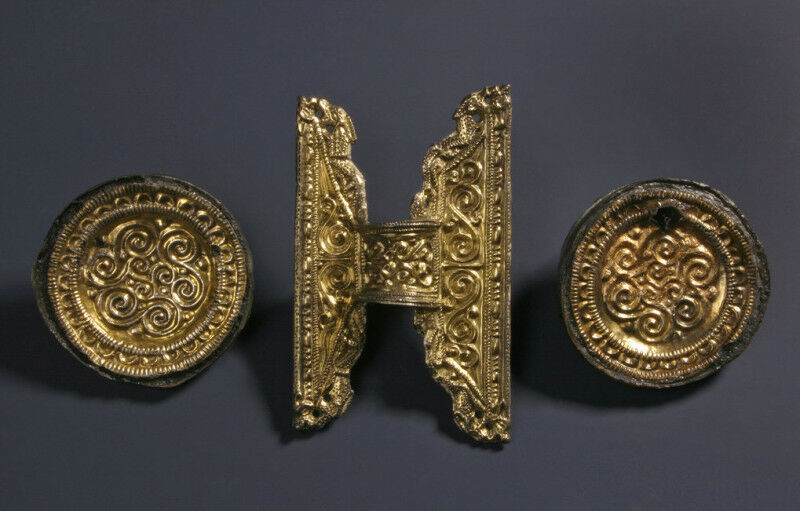
 Grave goods from inhumation grave 3532 at Issendorf cemetery in Lower-Saxony, Germany. Individuals buried at Issendorf cemetery during the Middle Ages are genetically closely related with people who migrated into England during the Anglo-Saxon period.
Archaeogenetic study reveals large-scale continental migration into the East of England during the early Medieval Period. Grave goods from inhumation grave 3532 at Issendorf cemetery in Lower-Saxony, Germany. Individuals buried at Issendorf cemetery during the Middle Ages are genetically closely related with people who migrated into England during the Anglo-Saxon period. Landesmuseum Hannover - In the largest early-medieval population study to date, an interdisciplinary team consisting of geneticists and archaeologists - led by the Max Planck Institute for Evolutionary Anthropology and the University of Central Lancashire - analysed over 400 individuals from ancient Britain, Ireland, Germany, Denmark and the Netherlands. The results show in detail one of the largest population transformations in the post-Roman world. Around three hundred years after the Romans left, scholars like Bede wrote about the Angles and the Saxons and their migrations to the British Isles. Scholars of many disciplines, including archaeology, history, linguists and genetics, have debated what his words might have described, and what the scale, the nature and the impact of human migration were at that time.
TO READ THIS ARTICLE, CREATE YOUR ACCOUNT
And extend your reading, free of charge and with no commitment.
Your Benefits
- Access to all content
- Receive newsmails for news and jobs
- Post ads