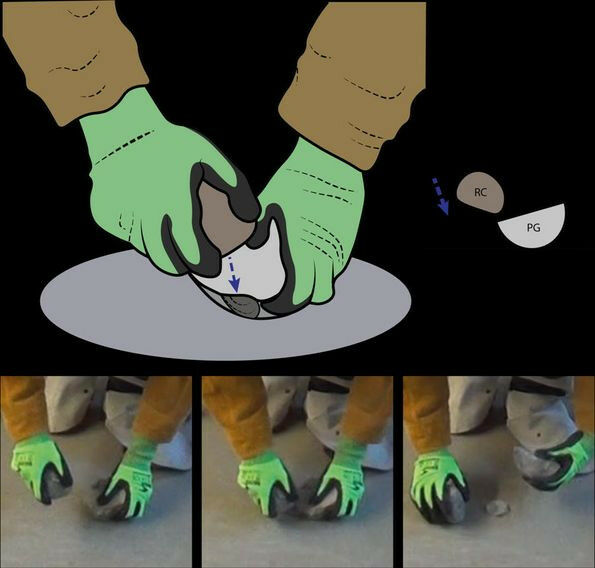
One participant of the study - who was naive to stone tools as well as any of their production techniques - uses the so-called bipolar technique. The resulting tool is seen centrally in the lower right.
One participant of the study - who was naive to stone tools as well as any of their production techniques - uses the so-called bipolar technique. The resulting tool is seen centrally in the lower right. Archaeologically excavated stone tools - some as much as 2.6 million years old - have been hailed as evidence for an early cultural heritage in human evolution. But are these tools proof that our an-cestors were already becoming human, both mentally and culturally? Dr. Claudio Tennie und William Snyder from the Department of Early Prehistory and Quaternary Ecology at the University of Tü-bingen have tested this traditional interpretation in a study funded by the European Re-search Council. They draw a different conclusion: as shown by an experimental study, the earliest techniques for making stone tools can be spontaneously reinvented even without cultural transmis-sion. They therefore are not evidence for the beginning of human culture, which possibly may have started much later, the researchers judge. The study was published in Science Advances .
TO READ THIS ARTICLE, CREATE YOUR ACCOUNT
And extend your reading, free of charge and with no commitment.