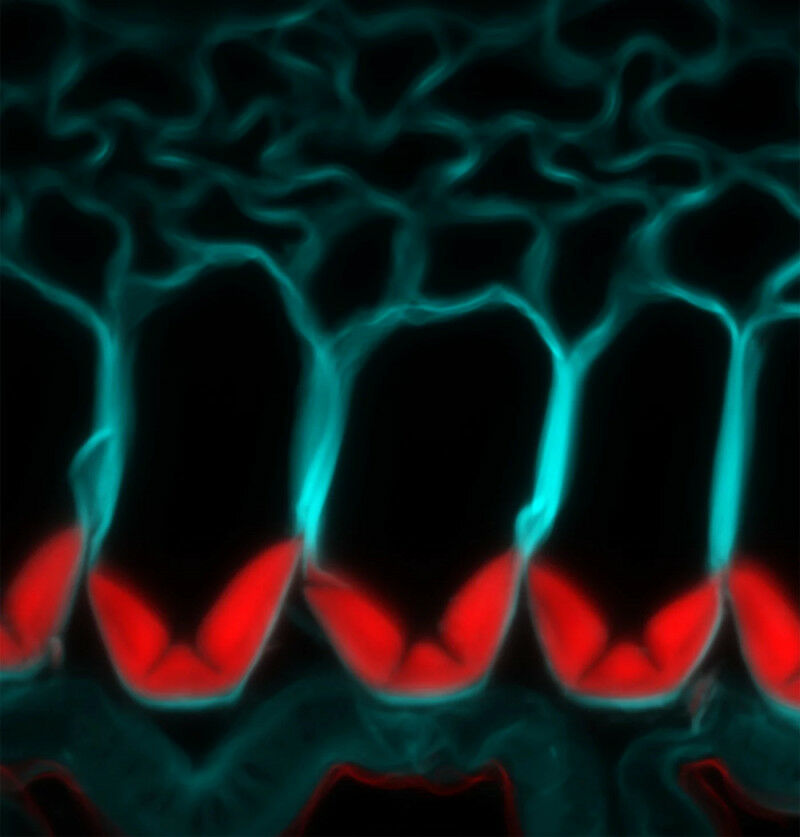
 A stiff polymer called lignin (stained red) is deposited in a precise pattern in the cell walls of exploding seed pods. Researchers identified three laccase enzymes required to form this lignin. No lignin forms in the cell wall (stained blue) when all three genes are knocked out by CRISPR/Cas9 gene editing.
A stiff polymer called lignin (stained red) is deposited in a precise pattern in the cell walls of exploding seed pods. Researchers identified three laccase enzymes required to form this lignin. No lignin forms in the cell wall (stained blue) when all three genes are knocked out by CRISPR/Cas9 gene editing. Miguel Pérez Antón - Researchers identify the genes controlling the mechanical structure of exploding seed pods Plants have evolved numerous strategies to spread their seeds widely. Some scatter their seeds to the wind, while others tempt animals and birds to eat their seed-filled fruits. And a few rare plants - such as the popping cress Cardamine hirsuta - have evolved exploding seed pods that propel their seeds in all directions. In their new study published in PNAS, Angela Hay and colleagues - from the Max Planck Institute for Plant Breeding Research in Cologne, Germany - investigate what genes control the mechanical structure of these exploding seed pods.
TO READ THIS ARTICLE, CREATE YOUR ACCOUNT
And extend your reading, free of charge and with no commitment.
Your Benefits
- Access to all content
- Receive newsmails for news and jobs
- Post ads