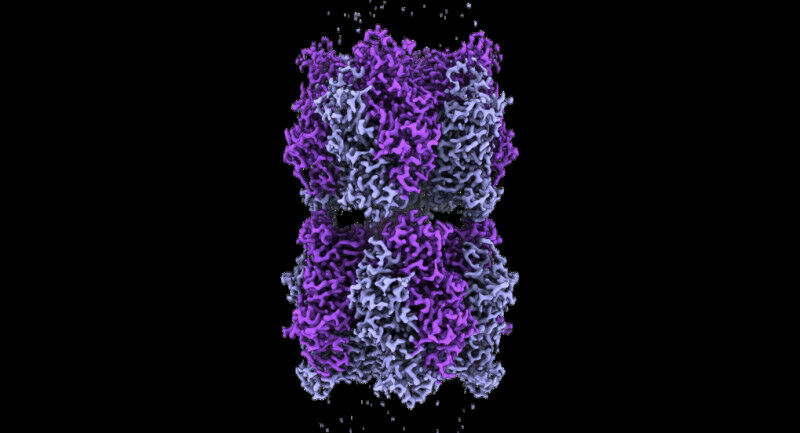
 Cryo-electron microscope image of two Rubisco complexes interacting with each other. If a subunit essential for solubility is missing, individual enzyme complexes can interact with each other in this way and form thread-like structures, so-called fibrils. Under normal conditions, however, Rubisco does not form such fibrils.
Resurrecting billon-year-old enzymes reveals how photosynthesis adapted to the rise of oxygen. Cryo-electron microscope image of two Rubisco complexes interacting with each other. If a subunit essential for solubility is missing, individual enzyme complexes can interact with each other in this way and form thread-like structures, so-called fibrils. Under normal conditions, however, Rubisco does not form such fibrils. MPI f. Terrestrial Microbiology/ L. Schulz - The central biocatalyst in Photosynthesis, Rubisco, is the most abundant enzyme on earth. By reconstructing billion-year-old enzymes, a team of Max Planck Researchers has deciphered one of the key adaptations of early photosynthesis. Their results not only provide insights into the evolution of modern photosynthesis but also offer new impulses for improving it.
UM DIESEN ARTIKEL ZU LESEN, ERSTELLEN SIE IHR KONTO
Und verlängern Sie Ihre Lektüre, kostenlos und unverbindlich.
Ihre Vorteile
- Zugang zu allen Inhalten
- Erhalten Sie Newsmails für Neuigkeiten und Jobs
- Anzeigen veröffentlichen