Three scientists involved in the QuPad project: Martin Wolff and Jonas Schütte, both members of the research group led by Carsten Schuck, and Wolfram Pernice (from left)
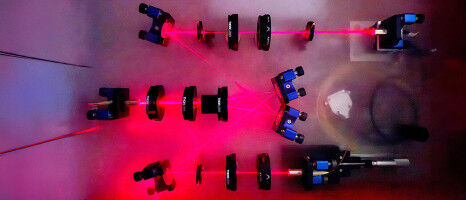
A giant cylindrical refrigerator, an electron-beam pattern generator, a cleanroom, etching equipment. Sometimes it takes a lot of big things to make something very small. The nanoscientists at the University of Münster headed by Prof. Wolfram Pernice and Prof. Carsten Schuck know this only too well: they use these and other devices to produce nanophotonic chips the size of a one-cent piece. These small chips, which also contain much smaller functional structures, can do a great deal - for example, contribute to the tap-proof transmission of data. Researchers at the University of Münster are currently working on developing a so-called quantum cryptographic process using these chips - a process that uses quantum information in the form of light particles to transmit data in encrypted form. Such transmission systems will become relevant at the latest when it is possible to develop a quantum computer that can attack today's encryption methods. The Federal Ministry of Education and Research (BMBF) is funding the project, "Ultrafast quantum key distribution by parallelization of detection channels", or QuPad for short, with 2.2 million euros, with the project, which began last November, running for at least two years.
TO READ THIS ARTICLE, CREATE YOUR ACCOUNT
And extend your reading, free of charge and with no commitment.
Your Benefits
- Access to all content
- Receive newsmails for news and jobs
- Post ads